Key Takeaways
-
A clear aligner treatment plan is a 3D digital simulation showing your starting tooth positions, proposed final positions, and the stages in between, but it is a proposed outcome, not a guarantee.
-
The number of stages equals the number of aligners in your series, not a guaranteed treatment time; wear consistency, refinements, and clinical decisions all affect how long treatment takes.
-
Check the bite view to see how your upper and lower teeth are expected to meet, and ask which bite issues, such as overbite, underbite, crossbite, or crowding, the plan targets.
-
Attachments are tiny tooth-colored bonded shapes that help aligners grip and move teeth; whether you need them, and how many, depends on your individual case.
-
IPR (interproximal reduction) is a controlled removal of a tiny amount of enamel between teeth to create room, so ask which teeth are involved and the planned amount.
-
Ask what the simulation does not show, and plan for retention after active treatment, since retainers help protect your results and plans can be refined if teeth move differently than predicted.
Imagine getting a sneak peek at your future smile before you even pop in your first aligner. That is the magic of a clear aligner treatment plan. It is a 3D digital roadmap that shows where your teeth are today, where your orthodontist hopes to move them, and the steps in between.
But if you have ever stared at one of these screens and thought, “What am I even looking at?” you are not alone. There are tiny bumps, colored arrows, numbers, and a slider bar. It can feel like reading a foreign language.
The good news? It is much easier to understand than it looks. In this friendly guide, we will walk through what a clear aligner treatment plan shows, how to read each part, and which questions to ask your orthodontist. Whether you are a parent helping your teen, a busy professional wanting a discreet fix, or someone returning for a second round after relapse, you will leave feeling confident and ready.

What Is a Clear Aligner Treatment Plan?
A clear aligner treatment plan is a digital simulation reviewed by your orthodontist. It is built from records like intraoral scans or impressions, plus photos and X-rays that help with diagnosis and planning. It compares your starting tooth positions with a proposed final arrangement.
Think of it like a GPS route for your smile. It shows your starting point, your destination, and the stops along the way. But just like a GPS, it is a plan, not a promise. Traffic, weather, and detours can change the trip. In orthodontics, your biology, how consistently you wear your aligners, and clinical decisions can all shape the journey.
At Brockway Orthodontics, we offer Spark™ Clear Aligners, and every plan starts with a careful exam. The software helps us design your treatment, but Dr. Brockway makes the clinical decisions, not the computer.
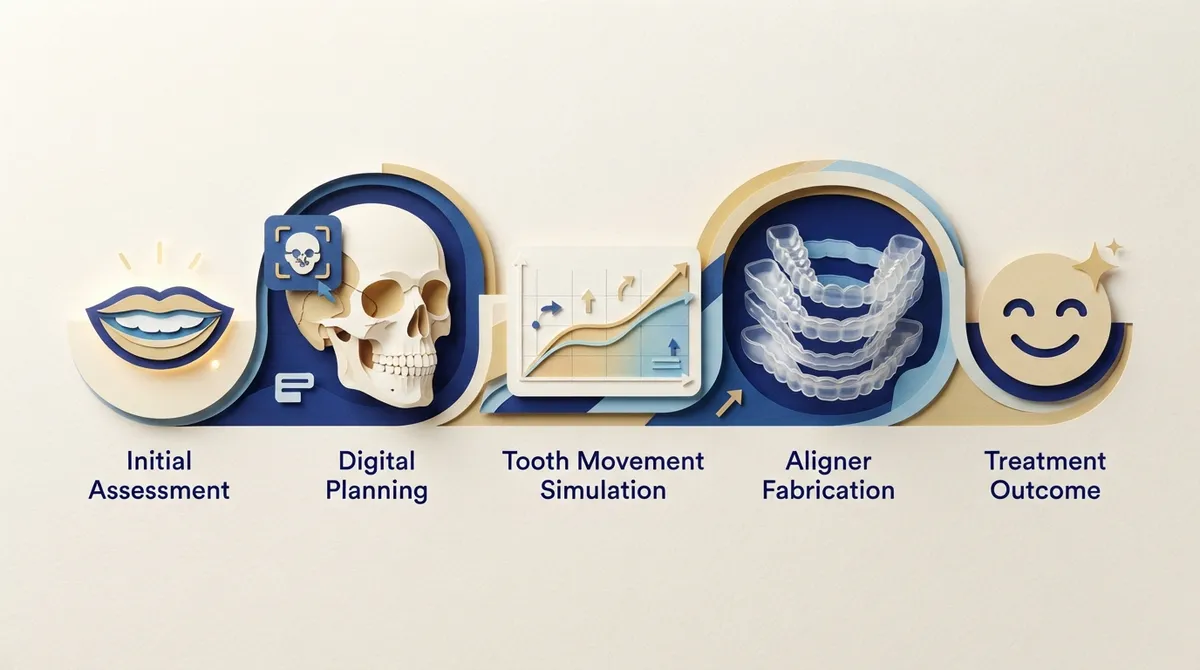
How to Read Your Clear Aligner Treatment Plan Step by Step
Ready to decode it? Here is a simple walkthrough of what to look for. Ask your orthodontist to open the plan on a screen and go through it with you. It works best as a conversation.
- Look at the starting position. This is your teeth as they are today, based on your scan.
- Look at the proposed final position. This is where the plan aims to move your teeth.
- Slide through the stages. Most plans let you step through the movements one at a time.
- Check the bite view. See how your upper and lower teeth are expected to meet.
- Spot the attachments and special notes. These are the small markers that show extra tools in the plan.
- Ask what is not shown. Every simulation has limits, and a good orthodontist will explain them.
Let us break each of these down.
The Starting and Final Tooth Positions
The first thing you will usually see is a before-and-after view. The “before” is your real teeth, captured by a digital scan. The “after” is the proposed arrangement your orthodontist designed for you.
This view can show proposed changes to:
- Alignment: how straight your teeth sit in a row
- Spacing: gaps that may close, or space that may be created
- Arch form: the overall curve and shape of your dental arch
- Rotations: teeth that are twisted and may be turned
It is tempting to treat that final image like a photo of your future smile. Try to remember it is a proposed outcome. Real tooth movement can differ because of individual biology, how well the aligners fit, the complexity of your case, and how consistently you wear them.
The Stages: What the Numbers and Slider Mean
Next, you will probably notice a slider or a count of steps. These are the stages of treatment. The plan breaks your tooth movement into small, gradual steps. Each stage generally matches one aligner in your series.
Here is a fun fact for the curious. A 2024 review reports that Invisalign staging defaults may limit planned movement per stage to about 0.25 mm for linear movement, 1 degree for angular movement, and 2 degrees for rotation. These are system-specific planning settings, not universal rules or guarantees. Different systems and different cases can vary.
So what does the number of stages tell you? It tells you how many aligners are in the plan. It does not guarantee how long treatment will take. Your timeline can change based on:
- How many hours a day you wear your aligners
- Missed or inconsistent wear
- How your teeth and bone respond
- Whether refinements are needed
- Decisions your orthodontist makes along the way
Think of the stage count like the number of songs on a playlist. It tells you how many tracks there are, but not how long you will listen to each one.
The Bite View: How Your Upper and Lower Teeth Meet
This is the part many patients overlook, and it matters a lot. A 3D plan can show how your upper and lower teeth are expected to meet at the end of treatment. That is your bite, also called occlusion.
Ask your orthodontist which bite goals are included. For example, are they trying to improve an overbite, an underbite, a crossbite, or crowding? If you are curious how bite problems are corrected, our guide on how braces fix a deep overbite explains the basics.
It is also smart to ask what the simulation does not establish. A digital view is helpful, but it does not replace a full exam. It cannot capture everything about how your jaw, muscles, and teeth work together.
Attachments: Those Little Bumps on Your Teeth
If you see small shapes or bumps drawn on some of your teeth in the plan, those are attachments. They are tiny bonded shapes made of tooth-colored composite. They help your aligners grip your teeth and apply the right forces.
Attachments are often used for movements that are harder for smooth plastic to do alone, such as rotating a tooth or moving it up or down. Whether you need them, and where they go, depends on your case and your orthodontist’s treatment design.
A 2025 systematic review of clear aligner studies found that, where it was reported, average attachment counts ranged from 6 to 11 per arch. That is a range from research, not a standard prescription. Your own plan may have more, fewer, or none.
Your plan may also mark other helpers, such as:
- Elastic hooks: small points that let you wear rubber bands to help move the bite
- Bite ramps: small platforms that can help adjust how your teeth come together
IPR: The Plan for Making Tiny Bits of Space
Sometimes your plan will show markings between certain teeth, along with small measurements. That is IPR, short for interproximal reduction. It means gently reshaping a tiny amount of enamel between selected teeth to create a little extra room.
It sounds scarier than it is. Your orthodontist does this in a controlled way, and the plan should identify which teeth are involved and the planned amount. A 2024 review describes IPR prescriptions commonly in the range of 0.2 to 0.5 mm per contact area in the literature it covered. The right amount for you is case-specific and must be decided and performed by a dental professional.
Why would a plan include IPR? Teeth that feel crowded need room to move. A 2025 expert consensus review describes five common ways to gain space in orthodontics:
| Space-Gaining Approach | What It Means in Simple Terms |
|---|---|
| Arch expansion | Gently widening the dental arch |
| Molar distalization | Moving back teeth farther back |
| Incisor proclination | Tipping front teeth slightly forward |
| Interproximal reduction (IPR) | Reshaping tiny amounts of enamel between teeth |
| Extraction | Removing a tooth when diagnosis calls for it |
Which of these, if any, shows up in your plan depends on your diagnosis. Many patients need none of them. Ask your orthodontist what is planned and why, and when and how it would be done.
What Is Not Shown in the Simulation
This part is just as important as what is shown. A treatment plan is a helpful picture, but it is not the whole story. Clear aligner care includes much more than the software preview:
- An exam and diagnosis before anything is designed
- Fitting your aligners and checking how they sit
- Monitoring your progress at visits
- Possible adjustments or extra aligners if teeth do not move as planned
- Retention after active treatment to help keep your smile in place
That last point is a big one. Even a great result needs to be protected. Learn more about retainers and keeping your smile straight so your hard work lasts.
What It Means If Your Plan Changes
Here is something that surprises many patients: plans can change, and that is normal. Teeth are living, and everyone responds a little differently. Your orthodontist may adjust the plan or prescribe refinement aligners if your teeth are not tracking exactly as expected.
Common reasons a plan may change include:
- Aligners not fitting snugly in certain areas
- Teeth moving slower or faster than predicted
- Inconsistent wear time
- New findings during check-ups
- Fine-tuning the bite near the end of treatment
Refinements are not a failure. They are a normal way to polish the final result. If you want to avoid common slip-ups, our article on Spark Clear Aligners mistakes to avoid has easy tips.
How Different Patients Can Use Their Plan
No matter who you are, your treatment plan can be a helpful tool. Here is how different folks can get the most from it.
Parents of Kids and Teens
Sit down together with your child and look at the plan. Ask how long the plan expects the first stage to take, how often aligners need to be worn, and what happens if an aligner is lost. Younger patients grow and change, so your orthodontist will watch how their jaws and teeth develop. You can read more about adolescent treatment and what to expect.
Teens and Young Adults
If you have a big event coming up, like graduation or a trip, ask which parts of the plan matter most for your timeline. Remember that wear time is a major part of staying on track. The more consistent you are, the smoother your stages tend to go.
Busy Adult Professionals
Look at the plan with your calendar in mind. Ask about the number of check-ups and whether attachments will be visible in your day-to-day life. Many adults appreciate how discreet clear aligners can be. Our guide on adult treatment covers what to expect.
Patients Returning After Relapse
If you had braces years ago and your teeth have shifted, your plan will start from your current positions, not your old ones. Ask your orthodontist what may have caused the shift and what retention plan will protect your new result.
Health-Conscious Patients
If you have gum concerns or a more complex dental history, share that early. Your plan should fit your overall oral health, not just the look of your teeth. Your orthodontist can coordinate with your dentist when needed.
Smart Questions to Ask About Your Plan
Ready to chat with your orthodontist? Here are some simple questions to bring along:
- What are the main goals of my plan?
- Which parts of my bite are being corrected?
- How many stages are planned, and what could change that number?
- Do I need attachments, and where will they go?
- Will I need IPR, and how much on which teeth?
- Are elastics or other helpers part of the plan?
- What does the simulation not show?
- What happens if my teeth do not move as expected?
- What will my retention plan look like?
You deserve clear, friendly answers, and a good orthodontic team will welcome your questions. If you are curious what a first appointment looks like, see what to expect at your first visit.
Why Local, Personalized Care Matters
Software can draw a pretty picture, but people make the plan work. At Brockway Orthodontics in Clearwater, Florida, Dr. Brockway takes time to listen to your goals, explain your options in plain language, and review your plan with you. We use modern technology like digital impressions and 3D imaging, which means no messy molds and a more precise starting point. You can meet Dr. Brockway to learn more about her approach.
Curious how clear aligners stack up against traditional options? Our article on clear aligners vs. braces can help you compare. We also offer metal braces and ceramic (clear) braces, so we can help you pick the option that fits your smile and lifestyle. And if cost is on your mind, learn about financing and insurance options. You can also see what neighbors say by reading Brockway Orthodontics reviews on Google.
For general guidance on dental health and orthodontic care, the American Dental Association and the Florida Association of Orthodontists are trusted resources. For those interested in the research, an expert consensus on clinical strategies for clear aligner treatment explains how clinicians approach planning.
Ready to See Your Own Smile Plan?
A clear aligner treatment plan shows a lot: your starting teeth, the proposed final positions, the stages in between, your bite goals, and any attachments, IPR, or helpers along the way. But it is a simulation, not a guarantee, and your orthodontist’s care, monitoring, and adjustments are what turn a plan into a real smile.
The best way to understand your plan is to see it with someone who can explain it. Book your free consultation online and we will walk you through your options in a friendly, no-pressure way. Prefer to chat first? Feel free to contact our team with any questions. We cannot wait to help you smile with confidence!
FAQs
Q: What does a clear aligner treatment plan show?
A: It shows a 3D digital simulation of your starting teeth, the proposed final positions, and the stages of movement in between. It may also show bite goals, attachments, IPR, and other helpers. Your orthodontist reviews it to make sure it fits your needs.
Q: Does a digital aligner preview guarantee my final result?
A: Nope, and that is an important thing to know! The preview is a proposed outcome, not a promise. Your biology, how well you wear your aligners, and your case complexity can all change how your teeth move, so your orthodontist keeps an eye on progress and adjusts as needed.
Q: What do the stages in my plan mean?
A: Each stage is a small step in your tooth movement, and each one generally matches an aligner in your series. The number of stages is not a guaranteed treatment time, since wear habits, refinements, and clinical decisions can all affect your timeline.
Q: Why does my plan show attachments and IPR?
A: Attachments are tiny bonded shapes that help your aligners grip and move teeth, while IPR is a small, controlled reshaping of enamel between teeth to create space. Whether you need either one depends on your case, and your orthodontist will explain exactly where and why.
Q: Why might my orthodontist change my plan or order refinement aligners?
A: Teeth do not always move exactly as the software predicts, and that is totally normal. If something needs fine-tuning, your orthodontist may revise the plan or order refinement aligners to help you reach the best possible result.
Our Service Area