Key Takeaways
-
Only about 1 in 3 orthodontists hold board certification, so finding one gives you a significant advantage for higher clinical standards and proven patient outcomes.
-
Board certified orthodontists must pass rigorous written and clinical ABO exams and renew their certification every 10 years with continuing education, ensuring they stay current with latest techniques.
-
You can verify board certification by searching the ABO’s online directory, asking the office directly, or checking the practice website for ABO credentials displayed prominently.
-
Board certification is voluntary—all orthodontists are licensed to practice, but certified ones have voluntarily demonstrated expertise beyond basic requirements through demanding examinations and case documentation.
Choosing the right orthodontist is one of the most important decisions you’ll make for your smile — or your child’s smile. With so many options out there, it can feel overwhelming. But here’s a simple tip that cuts through the confusion: look for a board certified orthodontist. This one credential tells you a lot about the quality of care you can expect. In this guide, we’ll walk you through exactly what board certification means, why it matters, and how to find a certified orthodontist who’s the perfect fit for your needs. Whether you’re a parent exploring options for your teenager, a young adult ready for a confidence boost, or someone returning to orthodontic care after some time away — you’re in the right place. Let’s make this easy and stress-free!

What Is a Board Certified Orthodontist?
A board certified orthodontist has gone above and beyond the standard requirements to practice orthodontics. All orthodontists must complete dental school plus a 2-3 year accredited orthodontic residency. But board certification is a voluntary extra step — and it’s a big one.
Board certification is awarded by the American Dental Association-recognized American Board of Orthodontics (ABO), which was established back in 1929. It’s the only specialty board recognized for orthodontic certification in the United States. When an orthodontist earns this credential, it means they’ve passed a series of tough examinations that go well beyond basic licensing requirements.

Licensed vs. Board Certified: What’s the Difference?
It’s easy to assume all orthodontists are equally qualified. But there’s an important distinction worth knowing.
|
Credential |
Required to Practice? |
Examination Required? |
Renewal Required? |
|---|---|---|---|
|
State License |
Yes |
Basic dental and specialty exams |
Yes (varies by state) |
|
ABO Board Certification |
No (voluntary) |
Written + Clinical ABO Exams |
Yes (every 10 years) |
A licensed orthodontist can legally treat patients. A board certified orthodontist has voluntarily proven a higher level of clinical knowledge and skill. Approximately only 1 in 3 orthodontists hold board certification — so finding one is a real advantage for patients who want the best possible care.
The ABO Certification Process Explained
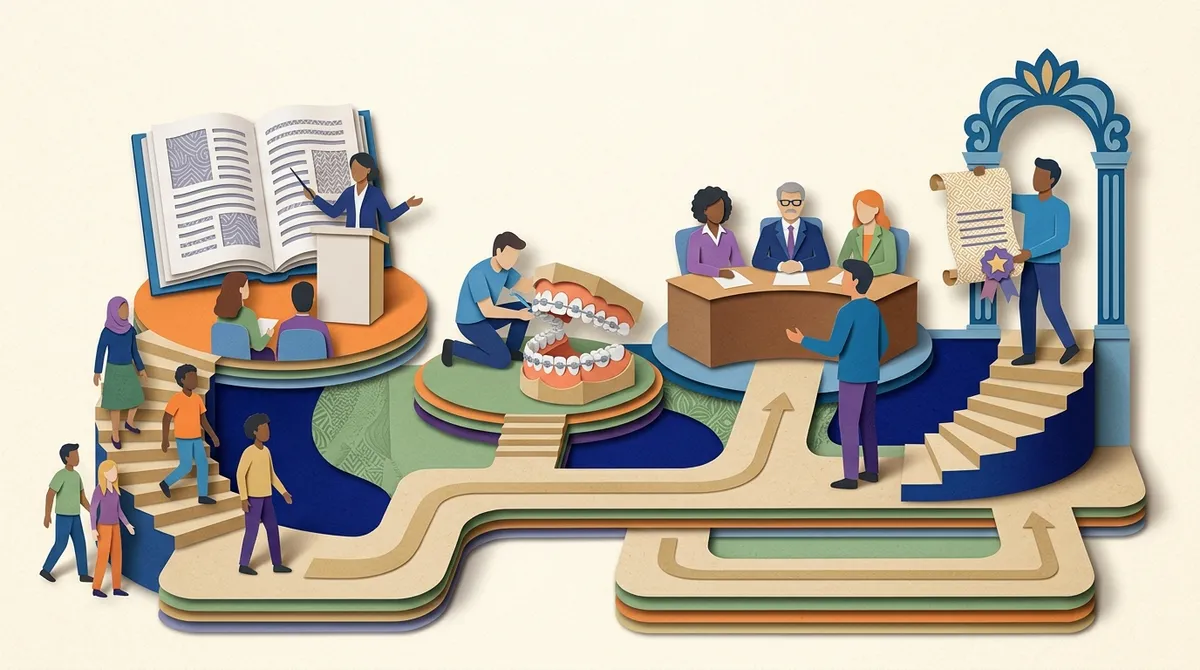
Wondering what an orthodontist actually has to do to earn board certification? It’s no small feat. Here’s a step-by-step breakdown of the process:
-
Complete an accredited orthodontic residency: The orthodontist must finish at least 18 months (typically 2-3 years) of a CODA-accredited orthodontic program before becoming eligible.
-
Pass the ABO Written Examination: This is a rigorous 240-question multiple-choice exam covering diagnosis, treatment planning, and clinical outcomes.
-
Submit detailed case reports: The orthodontist must present documented cases showing real patient results and treatment decisions.
-
Pass the ABO Clinical Examination: A panel of expert orthodontist examiners evaluates the candidate’s ability to diagnose, plan, and implement orthodontic treatment in real-world scenarios.
-
Maintain certification: Board certification isn’t a one-and-done deal. Renewal is required every 10 years, including completing 12 continuing education credits and passing an online Board Case Examination (50 questions, 90-minute time limit).
As you can see, this process is thorough and demanding. When you choose a board certified orthodontist, you’re choosing someone who has continuously demonstrated excellence in their field. Learn more about what to expect when you visit a specialist by checking out your first visit at Brockway Orthodontics.

Why Board Certification Matters for Your Family
Now that you know what board certification involves, let’s talk about why it genuinely matters for you and your loved ones. Here are the key benefits:
-
Higher clinical standards: Board certified orthodontists have proven their ability to achieve excellent patient outcomes.
-
Up-to-date knowledge: Renewal requirements ensure they stay current with the latest techniques and research.
-
Greater diagnostic accuracy: The certification process tests in-depth knowledge of diagnosis and treatment planning.
-
Peace of mind: Knowing your provider has voluntarily met the highest standards helps you feel confident in their care.
-
Commitment to excellence: Pursuing optional certification shows a dedication to the profession that goes beyond the minimum.
For parents making decisions about their children’s orthodontic care, these factors are especially reassuring. Explore early treatment options and adolescent treatment to learn how specialized care makes a difference at every age.
How to Find a Board Certified Orthodontist Near You
Ready to find a board certified orthodontist? Here’s a simple, practical approach:
-
Search the ABO’s online directory: The American Board of Orthodontics maintains a public directory of all board certified orthodontists. You can search by location to find certified specialists near you.
-
Ask directly: Don’t be shy! Call the orthodontic office and simply ask, “Is the doctor board certified by the American Board of Orthodontics?” A reputable practice will be happy to confirm this.
-
Check the office website: Most board certified orthodontists proudly display their ABO credentials on their website, in their bio, or in the office itself.
-
Read reviews and look at before-and-after results: Patient testimonials and case galleries can give you insight into clinical outcomes and the overall patient experience.
-
Schedule a consultation: A free consultation is a great opportunity to meet the doctor, ask questions, and get a feel for the practice’s approach and environment.
|
Step |
Action |
Why It Helps |
|---|---|---|
|
1 |
Search ABO Directory |
Confirms board certification status |
|
2 |
Ask the Office Directly |
Quick and straightforward verification |
|
3 |
Review the Website Bio |
Credentials are usually listed prominently |
|
4 |
Read Patient Reviews |
Real feedback on care quality |
|
5 |
Book a Free Consultation |
Meet the doctor before committing |
Questions to Ask During Your Orthodontic Consultation
Once you’ve found a board certified orthodontist, make the most of your consultation by asking the right questions. Here’s what we recommend:
-
Are you board certified by the American Board of Orthodontics?
-
What treatment options do you offer for my specific needs?
-
How long will treatment take, and what does the process look like?
-
Do you offer modern options like clear aligners or ceramic braces?
-
What does your patient follow-up and retention plan look like?
-
What financing or insurance options are available?
Asking these questions helps you feel informed and confident before starting treatment. You can also check out frequently asked questions and explore financing and insurance options to plan ahead.
What Treatments Can a Board Certified Orthodontist Offer?
A board certified orthodontist is trained to handle a wide range of treatment needs. Whether you’re dealing with a simple spacing issue or a complex bite problem, they have the skills to help. Common treatments include:
-
Traditional braces: Highly effective for all ages and a wide range of cases. Learn more about all about braces to see if this is the right fit for you.
-
Clear aligners: A discreet, removable option that’s especially popular with teens and adults. Check out Spark™ Clear Aligners as a modern alternative worth exploring.
-
Retainers: Essential for maintaining your results after active treatment. Visit our page on retainers for everything you need to know.
-
Early intervention: Addressing bite and alignment issues in young children before they worsen.
-
Adult orthodontics: Tailored solutions for busy adults who want effective, discreet treatment. Explore adult treatment options designed with your lifestyle in mind.
|
Treatment Type |
Best For |
Key Benefit |
|---|---|---|
|
Traditional Braces |
All ages, complex cases |
Maximum precision and control |
|
Clear Aligners |
Teens and adults |
Discreet and removable |
|
Retainers |
Post-treatment patients |
Preserves your results long-term |
|
Early Treatment |
Children ages 7-10 |
Prevents more serious issues later |
|
Adult Orthodontics |
Adults 25+ |
Efficient and lifestyle-friendly options |
Meet Dr. Brockway: Exceptional Care in Clearwater, FL
If you’re in the Clearwater, Florida area and searching for a highly qualified orthodontic specialist, look no further than Brockway Orthodontics. Meet Dr. Brockway and discover the personalized, patient-focused care that makes this practice stand out. From braces to clear aligners, the team offers a full range of orthodontic services designed to fit your life and your smile goals.
The Florida Association of Orthodontists supports high professional standards across the state, and practices like Brockway Orthodontics reflect that commitment to excellence every day. You can also visit us on Google to read patient reviews and learn more about the experience you can expect when you walk through our doors.
Whether you’re a first-time patient or returning for retreatment, we’d love to help you achieve the confident smile you deserve. Get started by exploring clear aligners in Clearwater with a free consultation or find out more about affordable braces in Clearwater.
Conclusion: Your Smile Deserves the Best
Choosing a board certified orthodontist isn’t just a smart decision — it’s an investment in the health and confidence that come with a beautiful smile. Board certification sets the gold standard in orthodontic care, ensuring that your provider has been rigorously tested, proven their skills, and committed to ongoing education. With only about 1 in 3 orthodontists holding this credential, finding one puts you in great hands.
Take the first step today. Book your free appointment online at Brockway Orthodontics and let us help you find the right treatment plan for a smile you’ll love for life. You’ve got this — and we’re here to help every step of the way!
FAQs
Q: What is the difference between a licensed orthodontist and a board certified orthodontist?
A: All orthodontists must be licensed to practice, but board certification is a voluntary credential awarded by the American Board of Orthodontics. It requires passing additional written and clinical examinations beyond basic licensing — only about 1 in 3 orthodontists earn this distinction!
Q: How long does it take to become a board certified orthodontist?
A: It’s quite a journey! After completing dental school and a 2-3 year orthodontic residency, orthodontists can begin the ABO certification process. From the start of the Clinical Examination, they have up to 10 years to complete all the certification components.
Q: How often must a board certified orthodontist renew their certification?
A: Board certification must be renewed every 10 years. Renewal includes completing 12 continuing education credits and passing an online Board Case Examination — so you can feel confident that your certified orthodontist is always staying sharp and up to date!
Q: Is board certification required to practice orthodontics?
A: Nope — board certification is completely voluntary! Any licensed orthodontist can legally treat patients. However, choosing a board certified orthodontist means you’re working with someone who has voluntarily gone the extra mile to prove their expertise and commitment to excellent care.
Q: How can I verify if my orthodontist is board certified?
A: Great question! You can check the American Board of Orthodontics’ official online directory, ask the orthodontic office directly, or look for the ABO credential listed on the practice’s website. Most board certified orthodontists are proud to display this achievement!