Key Takeaways
-
Costs vary by case: published Clearwater estimates range from about $2,800 to $6,500, but these are advertising figures, so your written estimate is the number that counts.
-
Ask for a written estimate showing total fee, down payment, and monthly amount, and check whether your dental insurance covers orthodontics and what its lifetime maximum is.
-
Options include traditional metal braces, ceramic braces, and removable clear aligners; only an orthodontist can recommend the right one after an exam.
-
Most patients wear braces about one to two years, and following instructions like wearing elastics and keeping teeth clean helps you finish on time.
-
Many orthodontists suggest a first checkup around age 7, which lets them monitor growth and spot issues early, even if braces aren't needed yet.
-
Choose an orthodontic specialist and confirm what the fee includes, how emergencies are handled, and what retainer care is recommended after treatment.
Thinking about braces in Clearwater, Florida? You’re in good company. Every year, kids, teens, and adults across Pinellas County take that first step toward a straighter, healthier smile. And that first step can feel a little overwhelming. Metal or clear? Braces or aligners? What will it cost? How long will it take?
Take a deep breath. This guide walks you through the choice one simple step at a time. You’ll learn what types of braces are out there, what drives the price, and which questions to ask before you commit. We’ll keep it friendly and jargon-free, like a chat with a neighbor who has been through it.
Whether you’re a parent planning for a middle schooler, a teen with prom on the calendar, or an adult who finally wants that smile you’ve always wanted, there’s a path that fits. Let’s find yours.
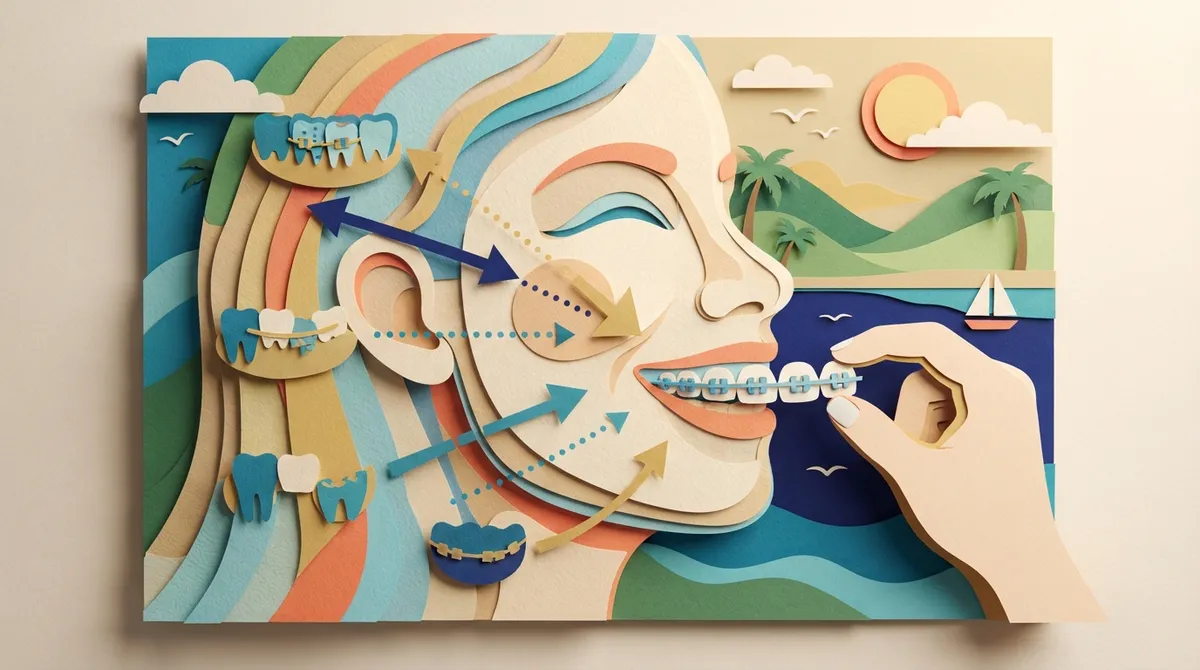
Step 1: Understand Why People Get Braces
Before you pick a style, it helps to know what braces actually fix. An orthodontist looks at your teeth and bite together, not just how your smile looks in photos.
Braces are commonly used to treat:
- Crowding: Teeth that overlap or twist because there isn’t enough room.
- Spacing: Gaps between teeth that don’t close on their own.
- Bite problems: Overbites, underbites, crossbites, and open bites that affect chewing and jaw comfort.
A straighter smile isn’t only about looks. Teeth that line up well are often easier to clean, and a balanced bite can feel better when you eat. If you’re curious about a specific issue, our guide on how braces fix a deep overbite shows what the process looks like.
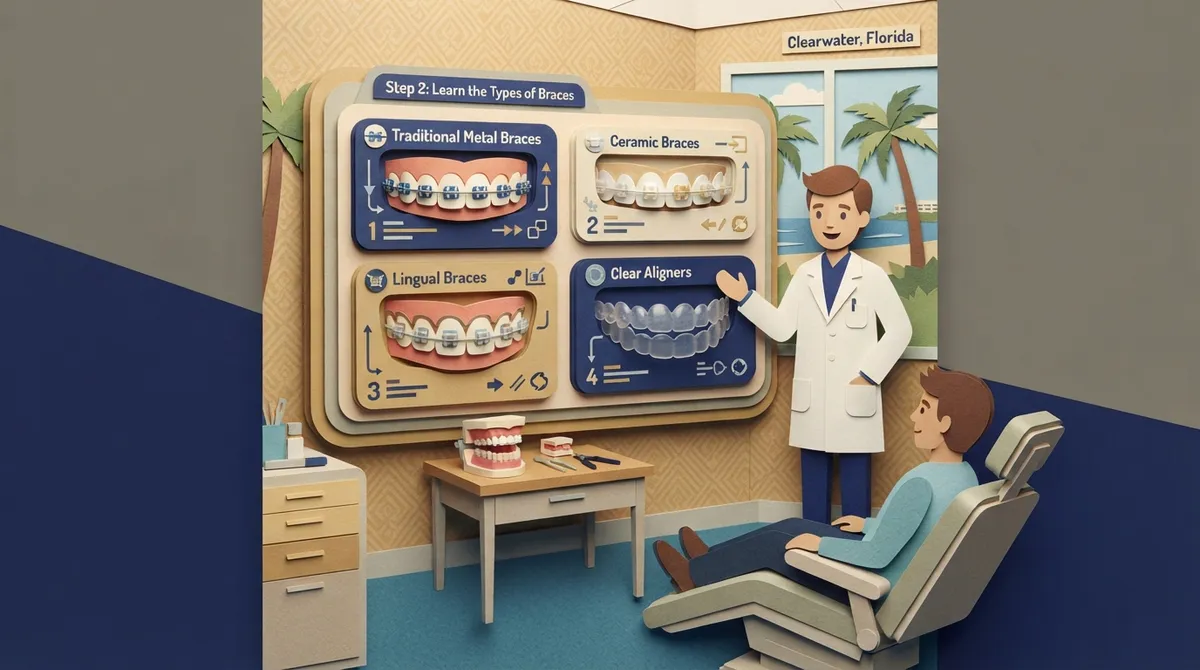
Step 2: Learn the Types of Braces in Clearwater
Clearwater orthodontic offices typically offer a few main options. Which one fits best depends on your teeth, your bite, and your lifestyle. Only an orthodontist can tell you for sure after an exam.
Traditional Metal Braces
Metal braces use small brackets and wires. They’re fixed to your teeth, so they work around the clock. They’re a reliable choice for kids, teens, and adults. Today’s brackets are smaller and more comfortable than the ones your parents may remember. Learn more in All About Braces.
Ceramic (Clear) Braces
Ceramic braces work like metal ones, but the brackets are tooth-colored or clear. That makes them less noticeable. They’re still fixed braces, so you can’t take them out. Many adults and image-conscious teens like this middle ground. See our take on ceramic braces in Clearwater.
Clear Aligners
Clear aligners are removable, nearly invisible trays you swap out every so often. They’re popular with busy professionals and teens who want a discreet look. They do need consistent wear, and they may not suit every case. At Brockway Orthodontics, we offer Spark™ Clear Aligners, a more affordable alternative to Invisalign.
| Option | Visibility | Removable? | Good to Know |
|---|---|---|---|
| Metal braces | Most visible | No | Fixed, works for many case types |
| Ceramic braces | Less noticeable | No | Tooth-colored or clear brackets |
| Clear aligners | Nearly invisible | Yes | Needs steady wear; not right for every case |
Step 3: Match the Option to Your Life
Your age and daily routine matter just as much as your teeth. Here’s how different people often think it through.
For Parents of Kids and Teens
Kids and teens are growing, which can make treatment more effective. Many orthodontists recommend a first checkup around age 7. That doesn’t mean braces start then. It just lets us watch how things develop. Read more about early treatment and our adolescent treatment options.
For Teens and Young Adults
Got graduation, prom, or a big trip coming up? Share the date with your orthodontist. They can help plan a timeline and talk through discreet options like ceramic braces or aligners. Our teen braces guide is a fun place to start.
For Adult Professionals
It’s never too late. Many adults choose less visible options to keep up with work and social life. If you want the details, see adult treatment or compare metal vs. clear braces for adults.
For Retreatment After Relapse
Did your teeth shift after old braces? It’s more common than you’d think, often because retainers weren’t worn long term. Retreatment can be a smart investment. A fresh evaluation will show what’s possible, and good retainers help keep the results this time.
Step 4: Understand What Braces Cost in Clearwater
Let’s talk money, because it’s usually the first question. The honest answer is that cost depends on your case. Complexity, the type of appliance, and how long treatment takes all play a role.
Here are some published estimates from local sources. Treat these as advertising estimates, not a citywide average or a personal quote:
- Brockway Orthodontics publishes a broad range of roughly $2,800 to $6,500 for braces, with monthly payments of about $99 to $225, depending on treatment and financing terms.
- A published guide lists estimated ranges of about $3,000 to $6,000 for metal braces and $4,000 to $7,000 for ceramic braces.
- Another Clearwater-area practice reports fees of $1,575 to $2,960 for Phase I treatment and $4,460 to $5,960 for a two-year Phase II case. Those are that practice’s own fees, not a market average.
- You may also see offers “starting at $149 per month.” A starting payment is not the total cost, and it may depend on down payment and eligibility.
The only number that really counts is the one in your written estimate. For a deeper look, check our friendly breakdown of braces costs and our guide to affordable braces in Clearwater.
Step 5: Sort Out Insurance and Payment Plans
Good news: you have options for spreading out the cost. Many Clearwater practices offer monthly payment plans, financing, and help with dental insurance. Terms vary a lot, so don’t assume.
Here’s a simple way to approach it:
- Check your benefits first. Ask your insurer if orthodontics is covered, what the lifetime maximum is, and whether there’s an age limit.
- Ask the office to verify coverage. A friendly front desk team can often help you read your plan.
- Request a written estimate. It should show your total fee, any down payment, and the monthly amount.
- Compare payment plans. Ask about interest, fees, and what happens if your plan changes.
We explain how this works on our financing and insurance page, and our tips on using dental insurance to help pay for braces can save you some headaches.
Step 6: Know How Long Treatment Usually Takes
Most people want a timeline, and that’s fair. Treatment length depends on how complex your case is and how well you follow instructions. Many patients wear braces for around one to two years, though some cases are shorter and some take longer.
Your part matters, too. Showing up to appointments, wearing elastics as directed, and keeping your teeth clean all help you finish on time. Our friendly timeline guide breaks it down further.
Step 7: Choose the Right Orthodontist
This might be the most important step. The person guiding your treatment matters as much as the braces themselves. When you compare Clearwater providers, ask:
- Is the clinician an orthodontic specialist?
- What does the quoted fee include, such as records, visits, and retainers?
- How are emergencies handled if a wire pokes or a bracket breaks?
- What retention care is recommended after braces come off?
- Will I get a clear, written treatment plan?
You can read more in how to find the right orthodontist in Clearwater. Dr. Brockway is a board-trained orthodontist who takes time to listen to your goals and explain your options in plain language. You can meet Dr. Brockway and see why local families trust her.
You can also see what patients say. Visit our Brockway Orthodontics location on Google to read real reviews from Clearwater families.
Step 8: Prepare for Your First Visit
A little prep makes your consultation smoother. Walking in with questions helps you feel in control. Here’s a quick checklist:
- Write down your goals, like straighter teeth, a better bite, or a smile for a big event.
- Bring your dental insurance card and any recent X-rays.
- List any health conditions or medications.
- Prepare your questions about cost, timeline, and appliance choices.
- Bring your child’s questions, too, if they’re the patient. Kids often feel better when they get to ask.
Want to know what happens in the chair? Peek at your first visit and our orthodontic consultation guide. Modern tools like digital scans and 3D imaging mean no goopy molds and a more precise plan. In some cases, same-day treatment is even possible.
Step 9: Plan for Life With Braces
Once your braces are on, a few simple habits keep things on track. You’ll want to watch certain foods, brush and floss with care, and call the office if something breaks.
- Avoid sticky and hard foods that can bend wires or pop brackets. Our foods to avoid list helps.
- Brush after meals and floss daily, using tools made for braces.
- Wear your retainer exactly as told once treatment ends.
Got a loose bracket or a poking wire? Don’t panic. Our guide on emergency orthodontic care explains what to do while you wait for an appointment.
Ready to Start Your Smile Journey?
Choosing braces in Clearwater, Florida doesn’t have to be stressful. Learn what each option does, get a written estimate, ask good questions, and pick an orthodontist you trust. That’s really the whole recipe.
For extra reading, the American Dental Association has helpful oral health resources, and the Florida Association of Orthodontists offers information about orthodontic care in our state. When you’re ready for answers specific to your smile, we’d love to meet you. Book your free consultation online and let’s map out your best smile together. Have questions first? Contact us any time, and our friendly team will be happy to help.
FAQs
Q: How much do braces cost in Clearwater, Florida?
A: It depends on your case, the type of braces, and treatment length. Published local estimates range from about $2,800 to $6,500, but those are advertising figures, not personal quotes. The best move is to ask for a written estimate after your exam.
Q: What types of braces are available in Clearwater?
A: Most local offices offer traditional metal braces, ceramic (clear) braces, and removable clear aligners. Your orthodontist will help you pick the one that suits your teeth, bite, and lifestyle.
Q: Are braces or clear aligners better for my teeth?
A: Neither is better for everyone. Braces work well for many case types, while aligners are discreet but need steady wear and may not fit every situation. An orthodontist can tell you which one is a good match after an exam.
Q: Does dental insurance cover braces in Clearwater, Florida?
A: Some plans do help with orthodontics, but coverage, limits, and exclusions vary a lot. Check your benefits first, and ask the orthodontic office to help verify them. Always get a written estimate so you know your out-of-pocket cost.
Q: At what age should a child see an orthodontist?
A: Many orthodontists suggest a first checkup around age 7. It doesn’t mean braces start right away. It simply lets the orthodontist watch growth and spot any issues early.
Our Service Area