Key Takeaways
-
Orthodontists must complete 2-3 years of CODA-accredited specialty training after dental school, which is essential for expertise in tooth movement, jaw alignment, and bite correction that general dentists lack.
-
Verify your orthodontist's credentials yourself by checking state dental license status online, confirming CODA-accredited residency, and using the ABO Orthodontist Locator tool to check board certification status.
-
American Board of Orthodontics (ABO) board certification is optional but represents significant commitment, requiring both written and clinical exams with 10-year renewal cycles to prove ongoing competency.
-
Product-specific certifications like Invisalign training are bonus skills that don't replace core credentials; always prioritize state license, dental degree, and CODA-accredited residency first.
-
Ask your orthodontist direct questions about their dental school, residency program accreditation, current licensing, board certification status, and recent continuing education during your consultation.
-
Over half of American Association of Orthodontists members are now board certified, making it a meaningful differentiator when choosing an orthodontist for complex or long-term treatment plans.
Picking an orthodontist can feel a little overwhelming, especially when everyone claims to be “the best.” Between fancy office signs and social media ads, how do you really know who’s qualified to straighten your smile? Here’s a friendly secret: it all comes down to credentials. Understanding orthodontist credentials and certifications helps you make a confident, informed choice for yourself or your family.
Whether you’re a parent researching braces for your teen, a busy professional considering clear aligners, or an adult ready for a smile do-over after years of relapse, this guide breaks it all down. We’ll walk through exactly what to look for, why it matters, and how to verify it yourself. By the end, you’ll feel like a credential-checking pro, ready to choose an orthodontist you can trust with your smile.

Why Orthodontist Credentials and Certifications Actually Matter
Your smile is worth protecting. Orthodontic treatment can take months or years, so you want someone who truly knows what they’re doing. Credentials aren’t just letters after a name. They represent years of education, testing, and hands-on training.
Think of it like hiring a pilot. You’d want to know they went through real flight school, not just a weekend workshop. The same logic applies to your teeth. A properly trained orthodontist understands bite alignment, jaw growth, and long-term treatment planning in ways a general dentist may not.
The Difference Between a Dentist and an Orthodontist
This is one of the most common questions patients ask, and it’s a great one. Every orthodontist starts out as a dentist, but not every dentist becomes an orthodontist.
- Dentists complete dental school and earn a DDS or DMD degree.
- Orthodontists complete dental school, then go on to additional specialty training.
- Orthodontic training focuses specifically on tooth movement, bite correction, and jaw alignment.
- This extra training typically takes two to three more years after dental school.
So while a general dentist can handle cleanings, fillings, and checkups, an orthodontist has specialized training just for straightening teeth and correcting bites. If you want to learn more about this distinction, check out our detailed breakdown on why you’d see an orthodontist instead of a dentist.
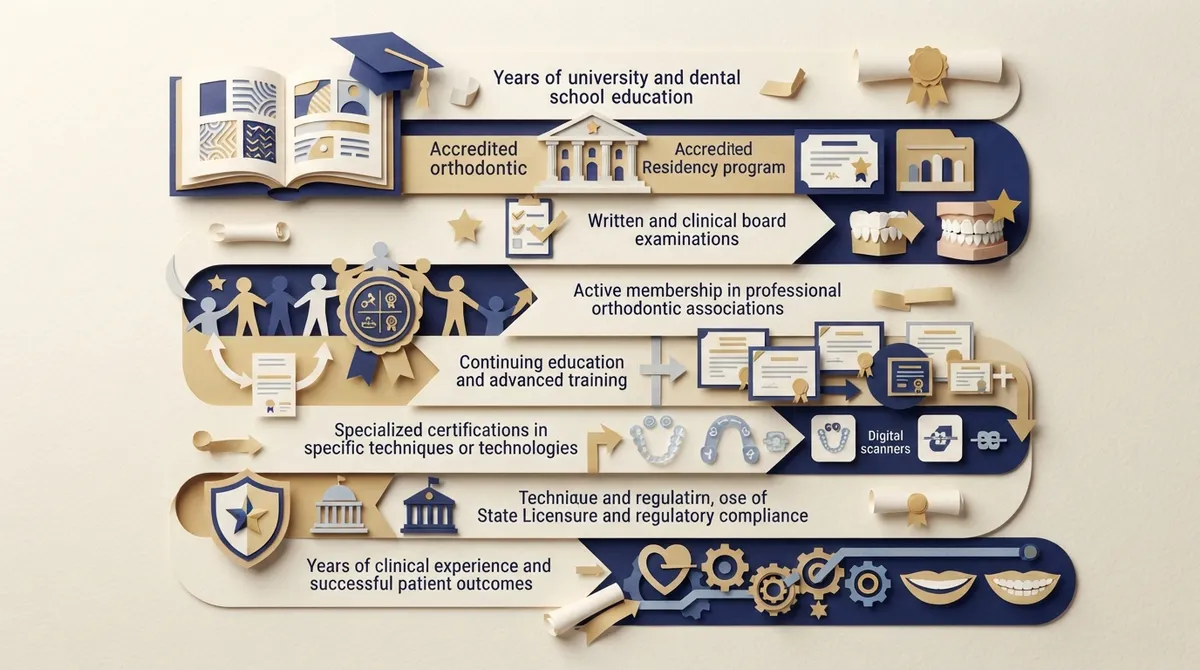
8 Orthodontist Credentials and Certifications Worth Checking
Ready for the good stuff? Here are the eight key credentials to look for when choosing an orthodontist for you or your family.
1. A Dental Degree (DDS or DMD)
Every orthodontist must first become a licensed dentist. This means completing four years of dental school and earning either a Doctor of Dental Surgery (DDS) or Doctor of Dental Medicine (DMD) degree. These two degrees are equivalent; schools just use different names.
2. An Active State Dental License
A license proves an orthodontist meets legal requirements to practice in their state. Licensing rules vary from state to state, including renewal periods and continuing education requirements. Patients can verify an active license through their state dental board, which only takes a few minutes online.
3. Completion of a CODA-Accredited Orthodontic Residency
After dental school, future orthodontists complete two to three more years of specialty training in orthodontics and dentofacial orthopedics. Look for a residency program accredited by the Commission on Dental Accreditation, often shortened to CODA. This accreditation confirms the program meets national education standards.
4. Specialty Training in Malocclusion and Jaw Alignment
This residency isn’t just about braces. It covers diagnosis, prevention, and treatment of misaligned teeth and jaws, plus facial growth patterns. This is exactly why finishing dental school alone doesn’t make someone an orthodontist. The specialty training is what builds true expertise.
5. American Board of Orthodontics (ABO) Board Certification
This one is optional, but it’s a big deal. The American Board of Orthodontics is recognized as the official certifying board for the orthodontic specialty. To become board certified, an orthodontist must pass both a written exam and a clinical exam.
According to the American Board of Orthodontics, more than half of orthodontists who belong to the American Association of Orthodontists are now board certified. That’s a meaningful commitment beyond the basic licensing requirements.
6. Membership in Professional Associations
Membership in groups like the American Association of Orthodontists or your state association shows an orthodontist stays engaged with the profession. However, membership alone is not the same as board certification. It’s simply a professional affiliation, not a tested credential.
7. Ongoing Continuing Education
Good orthodontists never stop learning. Continuing education keeps them updated on new techniques, materials, and technology, like digital scanning or the latest clear aligner systems. Ask your orthodontist what courses or training they’ve completed recently.
8. Product-Specific Training (Like Clear Aligner Certifications)
Terms like “Invisalign provider” or “clear aligner certified” describe training on a specific product. This is helpful information, but it doesn’t replace a dental license or board certification. Think of it as a bonus skill, not a core credential.
How to Verify These Credentials Yourself
You don’t have to just take someone’s word for it. Here’s a simple step-by-step process for checking credentials before your first visit.
- Ask where the orthodontist earned their dental degree.
- Ask where they completed their orthodontic residency.
- Confirm the residency was CODA-accredited.
- Check their license status through your state dental board website.
- Look up board certification status using the ABO Orthodontist Locator tool.
- Ask about continuing education they’ve completed recently.
- Read patient reviews and testimonials for real-world experiences.
This process takes maybe fifteen minutes total, and it gives you real peace of mind. It’s a small investment for a treatment that could last a year or longer.
Comparing Credential Types: What They Actually Mean
Let’s simplify this with a quick comparison table. It’s easy to mix up these terms, so here’s a clear breakdown.
| Credential | Required or Optional | What It Proves |
|---|---|---|
| State Dental License | Required | Legal permission to practice dentistry |
| CODA-Accredited Residency | Required for specialty | Completed orthodontic specialty training |
| ABO Board Certification | Optional | Passed written and clinical exams |
| AAO Membership | Optional | Professional association affiliation |
| Product Training (e.g., Invisalign) | Optional | Trained on a specific product or system |
What ABO Board Certification Really Involves
Since board certification comes up so often, let’s dig a little deeper. It’s a rigorous process, and not every orthodontist chooses to pursue it.
- Candidates must complete at least 18 months of a qualifying CODA-accredited program before taking the written exam.
- The written exam tests core orthodontic knowledge and clinical judgment.
- The clinical exam evaluates real treatment outcomes and decision-making skills.
- Outcomes assessment and critical analysis make up 25% of the clinical exam.
- Certification is time-limited for most diplomates and generally must be renewed every 10 years.
This renewal requirement is actually a good thing for patients. It means board-certified orthodontists must continue proving their skills over time, not just pass a test once and coast for decades.
Questions to Ask Your Orthodontist During a Consultation
A good consultation should feel like a conversation, not an interrogation. Still, it’s smart to come prepared with a few key questions.
- Where did you complete dental school and orthodontic residency?
- Is your residency program CODA-accredited?
- Are you currently licensed in this state?
- Are you board certified by the American Board of Orthodontics?
- What continuing education have you completed recently?
- How many years have you been treating patients like me?
A confident, experienced orthodontist will welcome these questions. If someone seems evasive or annoyed, that’s worth noting too. Your first visit is the perfect time to ask.
What This Means for Different Patients
Credentials matter a bit differently depending on your situation. Let’s break it down by patient type.
For Parents of Children and Teens
You want an orthodontist who understands growing jaws and developing bites. Ask about experience with early treatment and adolescent treatment specifically, since kids’ needs differ from adult cases.
For Teens and Young Adults
You probably care about results and style just as much as credentials. A board-certified orthodontist who also offers modern options like Spark™ Clear Aligners can give you both expertise and a discreet look.
For Adult Professionals
Your time matters. Look for an orthodontist with proven credentials and efficient treatment plans, ideally with adult treatment options that fit a busy schedule.
For Orthodontic Relapse Patients
If your teeth shifted after previous treatment, you need someone with real experience solving complex cases. Board certification can be a strong signal of that deeper expertise.
For Health-Conscious Individuals
If you have periodontal concerns or complex dental needs, credentials plus communication matter most. You want an orthodontist who explains their treatment plan in plain language.
Red Flags to Watch For
Not every red flag is obvious, so here’s a quick list of things that should make you pause.
- Vague or evasive answers about education and training
- No mention of state license verification
- Marketing that implies product certifications replace formal credentials
- Pressure to start treatment without a proper consultation
- Unwillingness to share before-and-after results from real patients
Trust your gut here. A qualified, confident orthodontist will happily share their background and answer your questions.
Why Location and Community Connection Matter Too
Credentials are essential, but so is finding a practice that feels like home. At Brockway Orthodontics, Dr. Brockway combines strong professional training with a genuine love for the Clearwater community. She takes time to listen to each patient’s goals, whether that’s a teenager wanting a fun smile transformation or an adult exploring braces options for the first time.
The practice also uses modern technology, including digital impressions and 3D imaging, to make treatment planning more precise and comfortable. Families appreciate that same-day treatment is sometimes available too, which helps busy schedules stay on track. You can browse the full range of services offered to see what fits your needs.
Curious what real patients think? You can visit us on Google — Brockway Orthodontics to read honest reviews from the community. It’s one more way to feel confident before booking your consultation.
A Quick Look at Treatment Options Once You’ve Chosen Your Orthodontist
Once credentials are confirmed, the fun part begins: choosing your treatment. Here’s a simple comparison of common options.
| Treatment Type | Best For | Visibility |
|---|---|---|
| Metal Braces | Complex cases, all ages | Visible |
| Ceramic Braces | Teens and adults wanting subtlety | Less visible |
| Spark™ Clear Aligners | Adults and teens wanting discretion | Nearly invisible |
Every treatment plan should be personalized. That’s why a proper consultation, backed by real credentials, makes such a difference in your results.
Bringing It All Together
Choosing the right orthodontist doesn’t have to feel complicated. Focus on the basics: a dental degree, active state license, CODA-accredited residency, and ideally, board certification from the American Board of Orthodontics. Everything else, like association memberships and product training, is a nice bonus, not a replacement for these core credentials.
For more general guidance on dental education standards, the American Dental Association offers helpful resources for patients. You can also check with the Florida Association of Orthodontists for state-specific information on licensed providers.
Ready to experience personalized, credential-backed orthodontic care in Clearwater? Our team would love to meet you and your family. Book your appointment online today and take the first step toward a smile you’ll love. You can also follow along on Instagram or Facebook to see real patient transformations and community updates.
FAQs
Q: What credentials should a qualified orthodontist have?
A: A qualified orthodontist should have a DDS or DMD dental degree, an active state dental license, and completion of a CODA-accredited orthodontic residency. Board certification from the American Board of Orthodontics is a wonderful bonus, though it’s optional rather than required.
Q: What is the difference between a dentist and an orthodontist?
A: Every orthodontist starts out as a dentist, but they go on to complete two to three more years of specialty training. This extra training focuses specifically on tooth movement, jaw alignment, and bite correction, which general dentists don’t receive.
Q: Is an orthodontist required to be board certified?
A: No, board certification through the American Board of Orthodontics is completely voluntary. It’s a great sign of extra commitment and skill, but a valid state license and CODA-accredited residency are the true legal requirements to practice.
Q: How can I verify an orthodontist’s license and board-certification status?
A: You can check your state dental board’s website to confirm an active license in just a few minutes. For board certification, simply search the ABO Orthodontist Locator tool online to see current status.
Q: Does an Invisalign certification make someone an orthodontist?
A: Not at all! Product certifications like Invisalign training show extra skill with a specific system, but they don’t replace a dental license or specialty residency. Always look for the core credentials first, then consider product training as a nice bonus.
Our Service Area