Key Takeaways
-
Neither braces nor clear aligners are automatically faster; research on mild-to-moderate crowding found low-certainty evidence of no significant difference between them.
-
Your diagnosis, bite complexity, and habits shape your timeline more than the appliance type, so a personal orthodontist exam is the best way to get a real estimate.
-
Braces typically take about 12 to 24 months for most patients, while aligners require wearing them roughly 20 to 22 hours a day to stay on schedule.
-
Missed appointments, broken brackets, lost aligner trays, and skipped elastics are common causes of delays that can add weeks or months to treatment.
-
Some extraction cases may finish faster with braces, though results vary across studies, so a specialist should assess your bite before you choose.
-
Retainers are part of the full timeline, so ask your orthodontist to break down records, appliance delivery, active treatment, refinements, and retention.
If you’re thinking about straightening your teeth, one of the first questions you probably have is, “How long will this take?” It’s a fair question! Whether you’re a parent planning around school activities, a teen with prom on the calendar, or a busy professional juggling meetings, time matters. And when it comes to comparing treatment timelines for braces and aligners, the honest answer might surprise you.
Here’s the friendly truth: neither option is automatically faster. Research shows that your own diagnosis, your bite, and your habits tell us much more about your timeline than the type of appliance you pick. In this guide, we’ll walk through what the evidence says, what can speed things up or slow them down, and how to get a realistic estimate for your own smile. Think of it as a chat over coffee, minus the jargon.
The Short Answer: Is One Faster Than the Other?
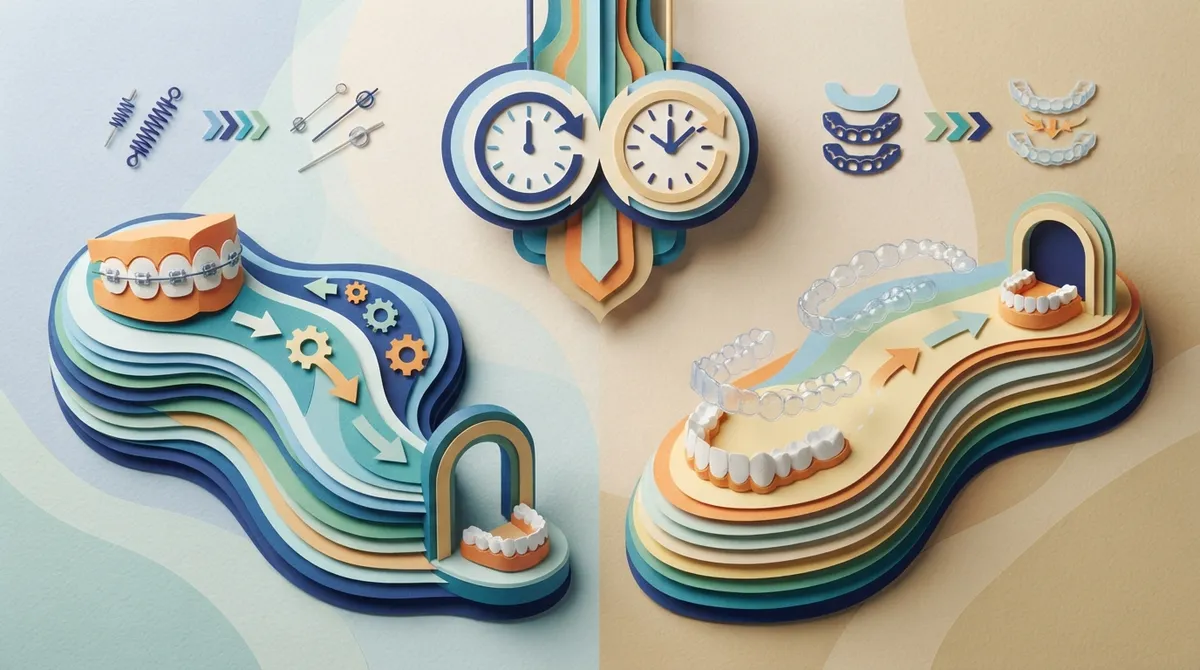
Many people assume clear aligners are the quick route. Others figure braces must win because they work around the clock. Neither idea holds up as a rule.
A 2024 systematic review looked at treatment duration for mild-to-moderate crowding. It found low-certainty evidence of no significant difference between clear aligners and fixed braces. The studies were so inconsistent that the authors could not combine their results. A 2025 review of aligner indications found a similar mix: some studies favored aligners, some favored braces, and some found no difference.
So what does that mean for you? It means the best question isn’t “Which is faster?” It’s “Which is the right fit for my teeth, and how long will my plan take?”
Typical Timelines at a Glance
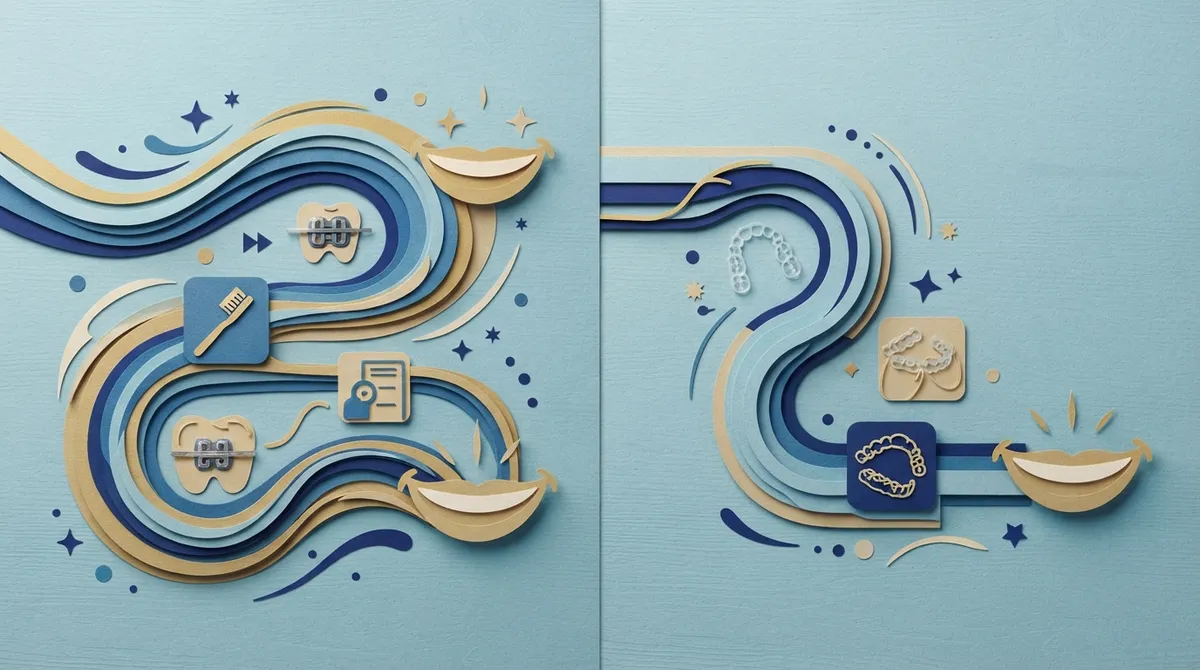
Let’s start with the general ranges. These are broad estimates, not promises. Your orthodontist will give you a personal one after an exam.
| Factor | Braces | Clear Aligners |
|---|---|---|
| General range | About 12–24 months for most patients, per the American Association of Orthodontists (AAO) | Varies by case; no single guaranteed range |
| Mild crowding or spacing | Can be as short as 8–12 months in some cases | Often similar, depending on the plan |
| Complex bite problems | May take a couple of years or more | May take longer, or may need extra steps |
| How it works | Fixed in place and working all day, every day | Removable, so progress depends on wear time |
| Extra steps | Finishing adjustments, possible elastics | Tray delivery time, possible refinement trays |
| After active treatment | Retainers needed | Retainers needed |
Notice how similar the two columns look? That’s the point. The appliance is only one piece of the puzzle.
What Really Decides Your Treatment Time
Your timeline is shaped by your unique mouth. Here are the biggest factors orthodontists look at:
- Severity of crowding or spacing: A little crowding takes less time than a lot.
- Bite problems: Overbites, underbites, and crossbites often need more complex tooth movement.
- Type of tooth movement: Rotating a tooth or moving a root takes more time than tipping a tooth.
- Extractions: Closing the space from a removed tooth adds time.
- Growth: In kids and teens, jaw growth can help, and your orthodontist can plan around it.
- Oral health: Healthy gums and teeth keep treatment on track.
- How well you follow instructions: This one is in your hands, and we’ll get to it next.
If you want to dig deeper into this, our guide on 6 things that decide braces treatment time in Clearwater breaks it down nicely.
Braces Timelines: What to Expect
Braces are bonded to your teeth, so they work constantly. You can’t forget to wear them, which is a big plus for busy families and teens.
According to the AAO, most people wear braces for about 12 to 24 months. Minor fixes may take only a few months, while complex cases can stretch to a few years. It’s a general range, not a prediction for any one person.
What Can Slow Braces Down
- Missed or rescheduled appointments
- Broken or loose brackets
- Inconsistent wear of rubber bands (elastics)
- Poor brushing that leads to gum trouble
Here’s a tip: small habits add up. A single broken bracket won’t ruin your plan, but repeated breaks can add weeks or months. If you want to avoid common slowdowns, take a peek at 7 mistakes that extend how long you need braces.
Where Braces May Shine
Some complex cases, especially those involving extractions, may move along faster with braces. A 2023 review of premolar-extraction cases found that most comparisons reported shorter treatment with fixed braces, though results weren’t uniform. That’s not a rule, but it’s a good reason to have a specialist look at your bite before choosing.
Aligner Timelines: What to Expect
Clear aligners are a series of custom trays you swap out in stages. They’re removable, which makes eating and cleaning easier. But that freedom comes with responsibility.
The AAO notes that aligners are usually worn about 20 to 22 hours a day. That’s most of your day and night! Taking them out too often, forgetting them in a lunch bag, or losing a tray can push your finish date back.
What Can Slow Aligners Down
- Wearing trays fewer than 20 hours a day
- Lost or broken trays
- Teeth not tracking as planned
- Needing refinement trays near the end
Aligner treatment also includes steps that don’t always show up in the “wear time” count. These can include manufacturing and delivery of trays, staged tray changes, and refinements if your teeth don’t move exactly as mapped out. If you’re curious how this works, read how removable aligners straighten teeth. And if you’ve ever wondered why extra trays sometimes show up, refinement aligners versus the original set explains it well.
Where Aligners May Shine
For mild-to-moderate crowding and spacing in a motivated patient, aligners can be a great, discreet option. Many adult professionals and teens love how little they show. Brockway Orthodontics offers Spark™ Clear Aligners, a more affordable alternative to Invisalign, for patients who want a clear option. You can learn more in what are Spark clear aligners.
Head-to-Head: Braces vs. Aligners by Situation
Let’s make this practical. Here’s how the two often compare in common situations.
| Situation | Braces | Clear Aligners |
|---|---|---|
| Mild crowding | Effective; timeline can be short | Effective; timeline often similar |
| Gaps between teeth | Effective | Effective; see our gap closure comparison |
| Severe crowding | Often well suited | May take longer or need refinements |
| Extraction cases | Often reported as shorter | May take longer in some studies |
| Complex bite correction | Strong control over tooth movement | Possible, but case selection matters |
| Reliance on patient habits | Low (always on) | High (must wear 20–22 hours a day) |
Remember, this table is a guide, not a verdict. The best way to know where your smile lands is a personal exam.
Who Tends to Fit Which Option?
Different people have different needs. Here’s how the timeline question often plays out for each group:
- Parents of kids and teens: Braces work around the clock, so you don’t have to remind a busy 12-year-old to pop trays back in. For younger kids, early checkups help with planning. See when your child should first see an orthodontist.
- Teens and young adults: If you’re motivated and responsible with your trays, aligners can fit around big events. If you prefer to “set it and forget it,” braces may suit you better.
- Adult professionals: Aligners are popular for their discreet look, but you’ll need to wear them most of the day. Ceramic braces are another low-profile choice.
- Relapse patients: If your teeth have shifted after earlier treatment, your timeline may be shorter than a first round, depending on how far things moved.
- Health-conscious patients: If you have gum concerns or complex dental needs, your plan will be customized, and the timeline will reflect that.
The Part People Forget: Retention
Here’s something many people overlook. Your treatment doesn’t end when your braces come off or your last tray is worn. Retainers help hold your new smile in place, and wearing them is part of the full timeline.
When you ask about “how long,” make sure you know what the estimate includes. It helps to ask your orthodontist to separate:
- Records and planning: Scans, photos, and X-rays.
- Appliance delivery: Bonding braces or receiving aligner trays.
- Active treatment: The time your teeth are actually moving.
- Refinements and finishing: Small tweaks to perfect your bite.
- Retention: The retainer phase that protects your results.
To plan ahead, check out how long you need to wear retainers after braces and why you still need retainers after clear aligners.
How to Keep Your Timeline on Track
Good news: you have more control than you might think. Whichever option you choose, these habits help you finish on time.
- Show up to appointments. Regular visits let us catch small issues early.
- Follow wear instructions. Aim for 20 to 22 hours a day with aligners, and wear elastics exactly as directed with braces.
- Protect your appliance. Avoid sticky or hard foods with braces, and keep aligners in their case when out.
- Brush and floss well. Healthy gums keep teeth moving smoothly.
- Call us early. A broken bracket or cracked tray is easier to fix when you speak up right away.
Want to make appointments easier? Our guide on keeping your clear aligner timeline on track has plenty of helpful ideas.
Time and Cost: Do They Connect?
Often, yes. A longer treatment can mean more visits and more supplies, which may affect your fees. It’s worth asking how your timeline connects to your cost. You can read more in how treatment length affects orthodontic costs, and compare options in clear aligners vs. braces cost.
Why a Personal Exam Beats Any Online Estimate
Online timelines are fun to read, but they can’t see your teeth. Only an orthodontist can look at your bite, your X-rays, and your goals, then give you a real estimate. At Brockway Orthodontics, we use modern tools like digital impressions and 3D imaging to plan your treatment precisely, with no messy molds. Dr. Brockway takes time to listen to your goals and explain your options in plain language, so you know exactly what to expect.
As a trusted orthodontist in Clearwater, Florida, our team treats the whole family, from kids to adults. In some cases, we can even offer same-day treatments, which is great for busy schedules. You can visit Brockway Orthodontics on Google to see what our Clearwater patients say about their experience. If you’re sorting through your choices, our guide Braces vs. Clear Aligners: Which Works Faster in 2026? is another helpful read, and you can also explore guidance from the American Dental Association and the Florida Association of Orthodontists for general oral health information.
Conclusion: Your Smile, Your Timeline
So, when it comes to comparing treatment timelines for braces and aligners, here’s the takeaway: neither one wins every time. Braces often land around 12 to 24 months, aligners can be similar for the right case, and your diagnosis, habits, and any refinements shape the final number. The best plan is the one built around your teeth, your life, and your goals.
Ready for a real estimate instead of a guess? We’d love to meet you. Book an appointment online and let’s map out your smile together, or contact us with any questions. Your best smile is closer than you think!
FAQs
Q: How long do braces usually take to straighten teeth?
A: The American Association of Orthodontists says most people wear braces for about 12 to 24 months. Minor fixes can take just a few months, while complex cases can take a couple of years or more. Your orthodontist can give you a personal estimate after an exam.
Q: Are clear aligners faster than braces?
A: Not always! Research on mild-to-moderate crowding found no clear difference in treatment time, and the evidence quality is low. Some studies favor aligners, some favor braces, and your own case matters most.
Q: How many hours a day do I need to wear clear aligners?
A: Aligners are usually worn about 20 to 22 hours a day, according to the AAO. That means wearing them nearly all day and night, taking them out only to eat, drink, and clean. Skipping wear time is one of the easiest ways to slow down your progress.
Q: What can make orthodontic treatment take longer?
A: Common slowdowns include missed appointments, broken brackets, lost aligner trays, and not wearing elastics or trays as directed. The severity of your bite problem and the need for refinements can also add time. Staying in touch with your orthodontist helps keep things on track.
Q: Do I still need a retainer after braces or aligners?
A: Yes, retainers are an important part of the full timeline. They help hold your new smile in place after active treatment ends. Your orthodontist will explain how long and how often to wear yours.
Our Service Area