Key Takeaways
-
Metal braces remain the most effective and affordable option for complex alignment and bite issues, while ceramic braces offer a less visible alternative at slightly higher cost for aesthetics-focused patients.
-
Clear aligners require consistent wear of 22 hours daily and work best for mild to moderate cases, making them ideal for disciplined patients who want a removable, nearly invisible option.
-
Lingual braces are virtually invisible but are the most expensive option with a speech adjustment period and cleaning difficulties, making them best suited for adults prioritizing complete discretion.
-
Self-ligating braces use built-in clips instead of elastic bands, potentially allowing longer intervals between appointments and offering greater comfort with less friction on teeth.
-
Treatment choice should be based on case complexity, appearance priorities, lifestyle discipline, budget constraints, and age—with children typically benefiting from metal braces and adults having more discretion-focused options available.
-
Professional evaluation is essential before age 7 for children and at any age for adults, as an orthodontist can assess your specific needs and create a personalized treatment plan matching your goals and circumstances.
Choosing the right orthodontic treatment is one of the most important decisions you can make for your smile. Whether you’re a parent researching options for your child, a teenager excited for straighter teeth, or an adult ready to finally tackle that bite issue — understanding the different types of braces is the perfect first step. The good news? There are more options than ever before, and one of them is almost certainly a great fit for your life, your goals, and your budget.
In this guide, we’ll walk you through every major type of braces available in 2026, what makes each one unique, and how to figure out which is the right choice for you. Let’s dive in!
What Are Braces and Why Do People Need Them?
Braces are orthodontic devices used to straighten teeth, close gaps, fix crowding, and correct bite problems. According to the American Dental Association, orthodontic treatment improves not just the look of your smile, but also your overall oral health. Misaligned teeth can be harder to clean, which can lead to cavities and gum problems over time.
Common issues that braces treat include:
- Crowded or overlapping teeth
- Gaps and spacing between teeth
- Crooked or rotated teeth
- Overbites, underbites, and crossbites
- General bite misalignment
The type of braces that works best for you depends on your specific dental needs, your age, your lifestyle, and your personal preferences. You can learn more about all about braces and how they work before your first appointment.
The 5 Main Types of Braces
Let’s break down the most common types of braces available today. Each has its own advantages, and your orthodontist will help you find the best fit during your consultation.
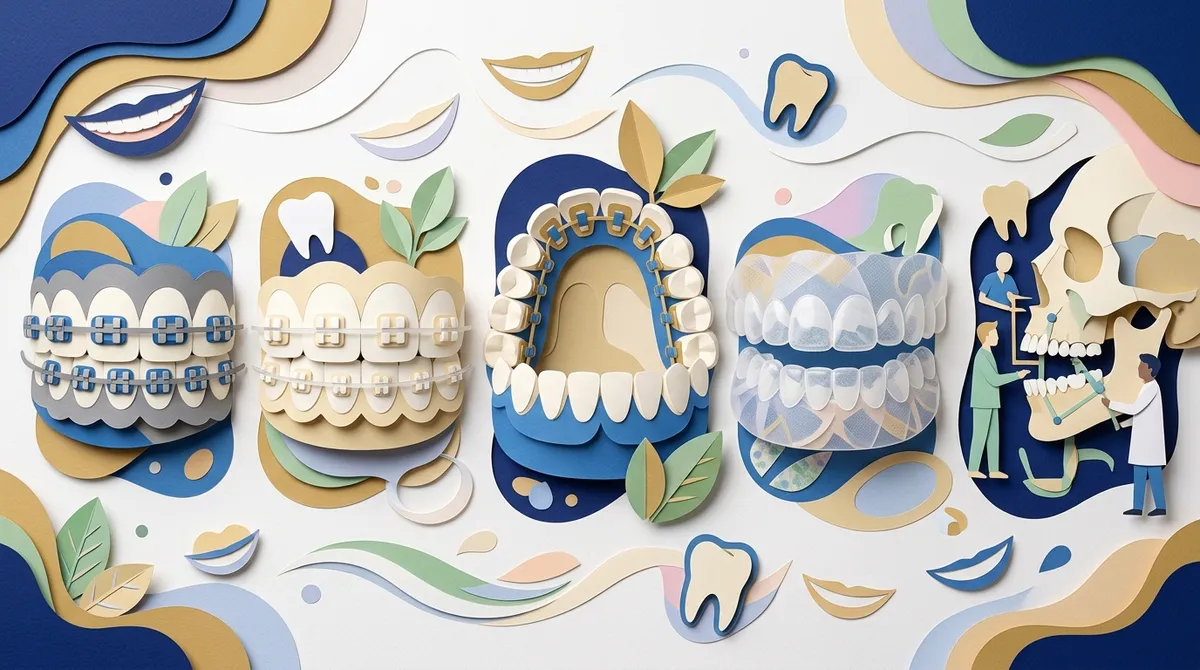
1. Traditional Metal Braces
Metal braces are the most well-known type of orthodontic treatment. They use metal brackets bonded to the front of each tooth, connected by a thin archwire. Your orthodontist periodically tightens the wire to guide teeth into position gradually.
Metal braces are still the most common option in specialist orthodontic practice, especially for cases that need significant tooth movement. They are highly effective, durable, and often the most affordable option. If you’re wondering about costs, this guide on factors that determine how much braces cost is a helpful resource.
Best for: Children, teens, and adults with complex alignment or bite issues who want a reliable, cost-effective solution.
2. Ceramic Braces
Ceramic braces work the same way as metal braces, but the brackets are made from tooth-colored or clear ceramic material. This makes them much less noticeable on the teeth. Many patients love the look of ceramic braces because they blend in naturally.
However, ceramic brackets can be slightly more fragile than metal brackets and may stain if you consume lots of coffee, tea, or dark-colored foods. They are generally a bit more expensive than traditional metal options. If you’re in the Clearwater area, you can explore ceramic braces in Clearwater and what makes the Brockway approach special.
Best for: Teens and adults who want a less visible alternative to metal braces without giving up the reliability of fixed orthodontics.
3. Self-Ligating Braces
Self-ligating braces look similar to traditional braces but use built-in clips or doors instead of elastic bands (ligatures) to hold the archwire. This small difference can make a big impact on your treatment experience.
Because there’s less friction between the bracket and the wire, self-ligating braces may allow for longer intervals between adjustment appointments. Many patients find them more comfortable since there’s less pressure on the teeth. They come in both metal and ceramic versions.
Best for: Patients who want fewer office visits and a potentially more comfortable treatment process.
4. Lingual Braces
Lingual braces are placed on the inside surface of your teeth — the side facing your tongue — rather than the outside. This makes them virtually invisible from the front. They are custom-made to fit the unique shape of each tooth’s inner surface.
Lingual braces are a fantastic option for people who want truly hidden orthodontic treatment while still using a fixed brace system. They do require an adjustment period, especially when it comes to speech, and they can be more difficult to clean. They are also typically the most expensive brace type.
Best for: Adults and professionals who want completely hidden fixed braces, particularly for aesthetic or career-related reasons.
5. Clear Aligners
Clear aligners are removable, custom-made plastic trays that gradually shift your teeth into position. They are not traditional braces in the fixed sense, but they are a widely popular alternative for patients with mild to moderate alignment needs. To be effective, clear aligners should be worn for about 22 hours per day.
At Brockway Orthodontics, we offer Spark™ Clear Aligners, a high-quality and more affordable alternative that delivers excellent results. Clear aligners are nearly invisible, easy to remove for eating and brushing, and very comfortable. For a detailed comparison, check out clear aligners vs. braces: which one is right for you?
Best for: Teens and adults with mild to moderate alignment issues who want a discreet, removable treatment option.
Quick Comparison: Types of Braces at a Glance
Here’s a side-by-side look at all five types to help you compare your options easily:
| Type of Braces | Visibility | Removable? | Best For | Relative Cost |
|---|---|---|---|---|
| Metal Braces | Visible | No | Complex cases, all ages | $ (Most affordable) |
| Ceramic Braces | Less visible | No | Aesthetics-focused patients | $$ |
| Self-Ligating Braces | Visible or less visible | No | Comfort-focused patients | $$ |
| Lingual Braces | Nearly invisible | No | Adults needing hidden braces | $$$ |
| Clear Aligners | Nearly invisible | Yes | Mild to moderate cases | $$-$$$ |
Pros and Cons of Each Type of Braces
It helps to see the advantages and drawbacks side by side. Here’s a detailed breakdown:
| Type | Pros | Cons |
|---|---|---|
| Metal Braces | Most effective for complex cases; durable; affordable | Visible; may cause minor discomfort after adjustments |
| Ceramic Braces | Less noticeable; same effectiveness as metal | Can stain; slightly more fragile; slightly pricier |
| Self-Ligating | Fewer appointments; potentially more comfortable | Can be pricier; not available at all practices |
| Lingual Braces | Virtually invisible; fixed system | Most expensive; harder to clean; speech adjustment period |
| Clear Aligners | Removable; nearly invisible; comfortable | Must wear 22 hrs/day; not ideal for complex cases |
How to Choose the Right Type of Braces
Choosing the right braces doesn’t have to feel overwhelming. Here are some key questions to ask yourself before your consultation:
- How complex is my case? Severe bite problems or heavy crowding often require fixed braces like metal or ceramic options for the best results.
- How important is appearance during treatment? If you’re in a client-facing job or want a discreet look, ceramic braces, lingual braces, or clear aligners might be the best fit.
- How disciplined can I be with a removable device? Clear aligners only work if you wear them consistently. Fixed braces remove that variable entirely.
- What is your budget? Metal braces tend to be the most budget-friendly, while lingual braces are typically the priciest. Financing options can make any type more accessible — learn about financing and insurance options available at Brockway Orthodontics.
- How old is the patient? Children and younger teens often do very well with metal braces. Older teens and adults may prefer a more discreet option. See what’s available for adolescent treatment and adult treatment.
The most important step is getting a professional evaluation. The Florida Association of Orthodontists recommends that children have their first orthodontic evaluation by age 7, though adults can benefit from treatment at any age.
Types of Braces for Different Ages
Not all types of braces are equally suitable at every stage of life. Here’s a helpful summary of what’s typically recommended by age group:
| Age Group | Most Common Options | Key Considerations |
|---|---|---|
| Children (7-12) | Metal braces | Early treatment can prevent bigger issues later |
| Teens (13-17) | Metal, ceramic, clear aligners | Lifestyle and aesthetics often factor in heavily |
| Young Adults (18-25) | Ceramic, clear aligners, lingual | Discretion and flexibility are priorities |
| Adults (25+) | All types, including self-ligating | Professional appearance and comfort matter most |
For parents exploring options for younger children, early orthodontic treatment can address developing issues before they become more complex. And if you’re an adult considering treatment, you’re in great company — so many adults are getting orthodontic treatment in 2026!
What to Expect at Your First Orthodontic Visit
Visiting an orthodontist for the first time is exciting — not scary! Here’s a simple step-by-step of what typically happens:
- Initial exam: Your orthodontist will examine your teeth, jaw, and bite. X-rays and digital scans may be taken.
- Treatment recommendations: Based on your case, the orthodontist will discuss which types of braces are suitable for you.
- Review your options: You’ll talk through each option, including timelines and costs.
- Ask questions: This is your chance to get all your questions answered. No question is too small!
- Create a personalized plan: Together, you and your orthodontist will design a treatment plan that fits your needs and goals.
At Brockway Orthodontics, your first visit is welcoming and informative. Dr. Brockway takes the time to listen to your concerns and explain every option in plain, friendly language. Visit us on Google — Brockway Orthodontics to read reviews from real patients and families who’ve experienced our care firsthand.
Busy schedule? No worries! In many cases, Brockway Orthodontics offers same-day treatments so you can get started right away without juggling multiple appointments. You can even schedule your free consultation online and take the first step toward your best smile today.
Life With Braces: What You Should Know
Getting braces is a journey — a fun and rewarding one! Here are some helpful things to keep in mind once you start treatment:
- Some mild soreness after adjustments is normal and usually fades within a few days
- Certain foods should be avoided with fixed braces (sticky candy, hard foods, etc.) — check out what you can eat with braces
- Good brushing and flossing habits are extra important during treatment
- After braces come off, you’ll need a retainer to keep teeth in their new position — learn about retainers and how they work
- Treatment length varies depending on the type of braces and complexity of your case
- Staying consistent with appointments is key to finishing on time
If life feels hectic and you’re juggling a big move along with orthodontic appointments, local services like DynaMight Movers can help take one thing off your plate so you can focus on your smile journey without the stress.
Why Choose Brockway Orthodontics in Clearwater
At Brockway Orthodontics, we make every patient feel at home from the moment they walk in. Meet Dr. Brockway — a highly trained, compassionate orthodontist who genuinely cares about your smile and your experience. She treats every patient like family, and that warmth shows in every appointment.
We offer metal braces, ceramic braces, and Spark™ Clear Aligners to give you flexible, effective treatment options at every life stage. Our modern technology, including digital impressions and 3D imaging, makes the process smoother and more comfortable. Whether you’re looking into teen braces in Clearwater or adult orthodontics in Clearwater, we have the right solution for you. Our full range of services is designed to serve the whole family with care and expertise.
We also believe great smiles shouldn’t break the bank. Flexible financing and insurance support make treatment accessible for families of all budgets. Follow along and see our work on the Brockway Orthodontics Facebook page for patient stories, tips, and community updates.
Conclusion: Your Perfect Smile Starts Here
Understanding the different types of braces is the first step toward making a confident, informed decision about your orthodontic care. Whether you choose sturdy metal braces, low-profile ceramic braces, discreet lingual braces, efficient self-ligating systems, or comfortable clear aligners — there’s a perfect option waiting for you.
The most important thing? Don’t wait. A healthier, more confident smile is closer than you think. Every journey starts with a single step, and that step is your first consultation.
Ready to find your perfect match? Book your free consultation at Brockway Orthodontics today and let Dr. Brockway guide you toward the smile you’ve always dreamed of. We can’t wait to meet you!
FAQs
Q: What are the different types of braces available today?
A: The main types of braces are traditional metal braces, ceramic braces, self-ligating braces, lingual braces, and clear aligners. Each works differently and suits different needs, budgets, and lifestyles. Your orthodontist will help you find the best fit during your consultation!
Q: Which type of braces is best for adults?
A: Adults often prefer ceramic braces, lingual braces, or clear aligners because they are more discreet. However, metal braces remain a great option for complex cases. The best choice really depends on your specific dental needs and personal preferences — and there’s truly no wrong answer!
Q: Are ceramic braces better than metal braces?
A: Ceramic braces are less visible than metal braces, which makes them popular with image-conscious patients. They work the same way but can be slightly more fragile and may stain over time. Metal braces are often more durable and budget-friendly, so it really comes down to what matters most to you.
Q: How do clear aligners compare to fixed braces?
A: Clear aligners are removable, nearly invisible trays that are great for mild to moderate alignment cases. Fixed braces — like metal or ceramic — are bonded to the teeth and are often better for more complex issues. The biggest difference? With clear aligners, you need to commit to wearing them about 22 hours a day for the best results.
Q: How long does orthodontic treatment take with different types of braces?
A: Treatment time varies based on the type of braces and the complexity of your case. On average, most treatments last between 12 and 24 months. Your orthodontist will give you a personalized timeline after evaluating your teeth and bite — every smile journey is unique!