Key Takeaways
-
An early orthodontic visit at around age 7 is a check-up for looking and planning, not a commitment to braces; many children leave with no treatment or a monitoring plan.
-
Orthodontic timing depends on growth, and treatment often begins between ages 9 and 14, so starting too soon can mean longer care without extra benefit.
-
After the first exam, outcomes typically fall into three groups: no treatment needed, monitoring with periodic reviews, or early (Phase 1) treatment for a specific problem.
-
Monitoring is an active, planned strategy in which the orthodontist tracks jaw growth and tooth eruption so treatment can start when it will work best.
-
Early treatment may help with issues such as crossbites, severe crowding, protruding teeth, retained baby teeth, or uneven jaw growth, but only an orthodontist can confirm this after an exam.
-
Parents who spot a concern before age 7 do not need to wait, and it is never too late for a check-up, since teens and adults can also get evaluations.
If you have ever heard that your child should see an orthodontist by age 7, you may have felt a little jolt of worry. Does that mean braces are coming? Will your seven-year-old be wearing metal in the school photo? Take a deep breath, because the answer is almost always no. Understanding why early evaluation does not mean immediate treatment can help you feel calm, confident, and ready to make good choices for your family.
Think of an early orthodontic visit like a well-child checkup. The doctor looks, measures, and talks with you. Most of the time, the plan is simply to keep an eye on things. Sometimes, a small step now can help later. Either way, you walk out with answers instead of guesses.
In this friendly guide, we will walk through what an early visit really is, what can happen afterward, and how to get the most from it. Whether you are a parent of a young child, a teen, or even an adult wondering about your own bite, you will find clear, honest information here.

What an Early Orthodontic Evaluation Really Is
An early evaluation is a check-up, not a commitment. The American Association of Orthodontists (AAO) recommends a first orthodontic visit when a concern is first noticed, and no later than age 7. That is a milestone for looking and planning. It is not a recommendation to start braces at age 7.
Why age 7? By then, children usually have a mix of baby teeth and new permanent teeth. This gives an orthodontist a helpful window to see how the bite, jaws, and teeth are coming together.
What the Orthodontist Looks For
During the visit, the orthodontist checks how your child’s teeth and jaws are developing. Here is what often gets a close look:
- Bite: How the upper and lower teeth meet
- Jaw growth: Whether the jaws are growing in a balanced way
- Spacing: Whether there is too much or too little room for teeth
- Eruption: How permanent teeth are coming in and whether baby teeth are falling out on time
Notice that none of this requires an appliance. It is simply information gathering. You can learn more about what this first visit feels like in our guide on what to expect at your first orthodontist appointment.
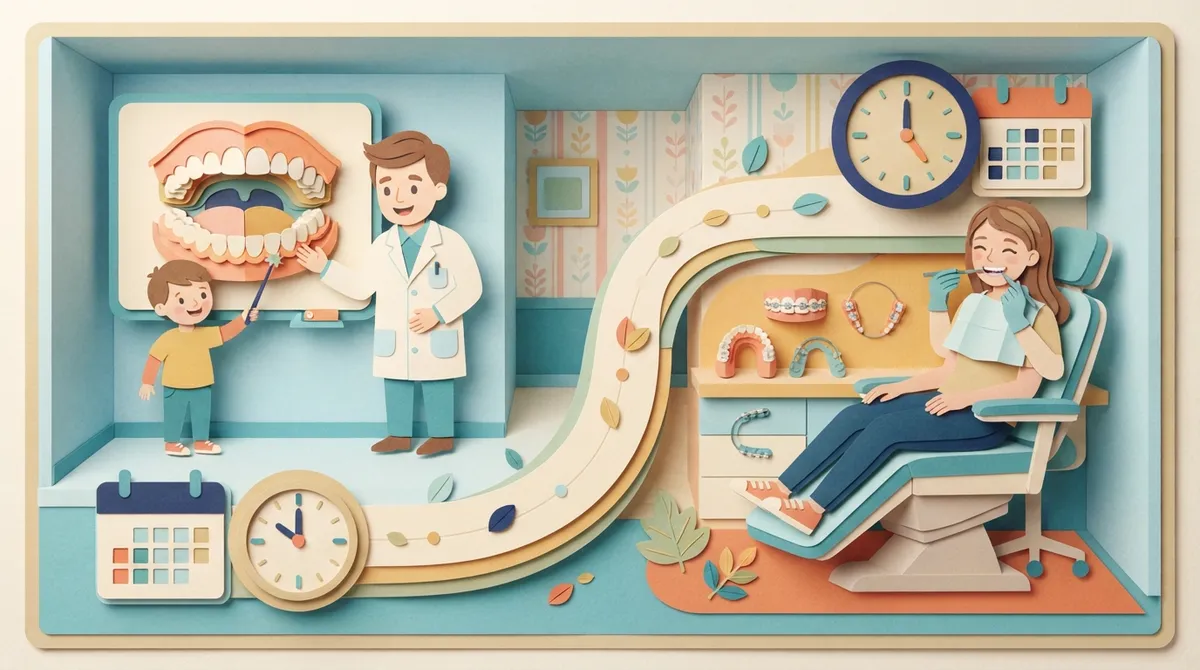
Why Early Evaluation Does Not Mean Immediate Treatment
Here is the heart of it. An early visit answers one big question: “Is there something happening that we need to act on now, or can we simply watch and wait?” For many children, the answer is to watch and wait.
Orthodontic timing depends on growth. Teeth and jaws change a lot between ages 6 and 13. The American Academy of Pediatric Dentistry (AAPD) describes this mixed dentition stage as roughly ages 6 to 13. Starting treatment too soon can mean longer care without extra benefit. Starting at the right time can make things smoother.
The AAO also notes that orthodontic treatment often begins between ages 9 and 14. That is a general range, not a deadline. Every child grows at their own pace.
The Question Orthodontists Ask
Good orthodontists weigh one simple question: does treating now offer a real benefit over waiting? The AAPD says timing depends on the specific dental or skeletal problem, the child’s growth, and the risks and benefits of treating now versus later. If waiting will not make things harder, there is no rush.
The Three Possible Outcomes After an Early Visit
After the exam, most children fall into one of three groups. Knowing these can take a lot of pressure off the first appointment.
| Outcome | What It Means | What Happens Next |
|---|---|---|
| No treatment expected | Teeth and jaws look to be developing well | Routine dental care and a check-in if concerns arise |
| Monitoring | Something may need care later, but not yet | Periodic reviews to track growth and tooth eruption |
| Early (interceptive) treatment | A specific problem may benefit from acting during growth | A focused, limited plan, often called Phase 1 |
As you can see, only one of the three involves starting treatment. The other two are about watching and reassuring.
Option 1: No Treatment Needed
Good news happens often! Some children simply have healthy, well-developing bites. You leave with peace of mind and a smile.
Option 2: Monitoring
This is a very common result, and it is an active part of care. Regular reviews let your orthodontist track growth and tooth eruption. That way, if treatment becomes helpful, it can be timed to your child’s development rather than started too soon.
Option 3: Early or Interceptive Treatment
Sometimes acting early helps. Early treatment, also called Phase 1, may be right for selected problems where guiding growth could make a difference. It is not needed for every child, and many concerns are better handled after more permanent teeth have come in. If you are curious, our overview of phase one vs phase two orthodontics explains the difference in plain language.
How to Prepare for an Early Orthodontic Visit
A little preparation makes the visit smoother and more helpful. Here is a simple step-by-step plan.
- Write down your concerns. Note anything you have noticed, such as crowded teeth, a shifted jaw, thumb sucking, or teeth that came in late.
- Gather dental history. Bring any recent dental records, X-rays, or notes from your family dentist.
- Talk to your child. Explain that it is a check-up, like a school photo for their teeth. Keep it light and positive.
- List your questions. Ask about timing, costs, and what to watch for at home.
- Plan for follow-up. Ask how often reviews would happen if treatment is postponed.
For more ideas, see our tips on how to prepare first appointment questions.
Why Monitoring Is a Smart Plan, Not a Delay
Some parents worry that “wait and see” means “ignore it.” It does not. Monitoring is a planned, active strategy. Think of it like watching a garden grow. You do not pull up the seedlings to check on them. You keep an eye on them and step in at the right moment.
Benefits of Watching Growth
- Better timing: Treatment can start when it will work best
- Less guesswork: Each visit gives a clearer picture of how things are changing
- Fewer surprises: Problems get spotted before they become harder to fix
- Comfort for your child: Kids get used to the office in a low-pressure way
Regular reviews also fit into the bigger picture of dental health. Learn why orthodontic checkups matter so much, even when no braces are involved.
What Kinds of Problems May Benefit From Early Treatment?
While many kids can wait, some situations may call for earlier action. Only an orthodontist can tell you for sure after an exam, but here are common examples that families ask about:
- A crossbite, where upper and lower teeth meet in an unusual way. Our post on crossbite treatment explains when it matters.
- Severe crowding or lack of space for permanent teeth. See what causes crowding in children’s developing teeth.
- Teeth that are protruding and may be at higher risk of injury
- Baby teeth that do not fall out on time. Read about retained baby teeth.
- Jaw growth that seems uneven
Even in these cases, “early” does not always mean “braces right now.” Sometimes the answer is a small appliance, and sometimes it is just a closer watch.
Common Worries Parents Have (and Honest Answers)
Let’s tackle a few feelings that often come up, because you are not alone in having them.
“Will my child need braces if we go at age 7?”
Not necessarily. The visit is meant to look and plan. Many children leave with a monitoring plan or no treatment at all.
“Did we wait too long if we are past age 7?”
Not at all. It is never too late to see an orthodontist. Age 7 is a helpful target, but families come in at many ages. If you are unsure about timing, our guide on age 7 vs. waiting can help.
“What if I notice a concern before age 7?”
You do not need to wait. AAO guidance says that if a parent spots a concern early, they can seek an evaluation right away.
Early Evaluation for Teens, Adults, and Retreatment
While the age 7 guideline is about kids, the idea behind it applies to everyone: a visit is information first, a decision second.
Teens often come in wondering about braces or clear aligners before a big event. An evaluation helps them understand their options and timeline. Take a look at our list of questions teens should ask their orthodontist.
Adults, including busy professionals and those whose teeth have shifted after earlier treatment, can also book a consultation just to learn where they stand. No pressure, no obligation to begin. If this sounds like you, read about orthodontics for adults in Clearwater.
How Brockway Orthodontics Approaches Early Visits
At Brockway Orthodontics in Clearwater, Florida, we believe a first visit should feel welcoming, not stressful. Dr. Brockway takes time to listen to your concerns and explain what she sees in simple terms. You will know your options before you leave, and you will never be rushed into a decision.
Our office uses modern tools like digital impressions and 3D imaging, which means a more comfortable experience without messy molds. When treatment is the right call, we offer metal braces, ceramic braces, and Spark™ Clear Aligners. You can see what our Brockway Orthodontics patients say on Google to get a feel for the care we provide. You can also learn more about Dr. Brockway before your visit.
A Simple Way to Think About It
Here is an easy comparison to keep in mind. An early evaluation is like a map check before a road trip. You are not leaving yet. You are just making sure you know the route, the timing, and whether any detours are needed.
| Early Evaluation | Active Treatment |
|---|---|
| A check-up and planning visit | Braces, aligners, or appliances in use |
| Gives you information | Moves teeth or guides jaw growth |
| Often ends with monitoring | Follows a specific plan and timeline |
| No commitment needed | Requires regular adjustments and care |
Final Thoughts: Information Is the Real Goal
The main takeaway is simple. Seeing an orthodontist early is about knowing, not rushing. You get a clear picture of how your child’s smile is growing, and you get to decide what comes next with a professional you trust. For many families, that means monitoring and reassurance. For some, it means a small, well-timed step. For all, it means fewer unknowns.
You can also get a sense of costs and options by reading our guide on free vs. paid braces consultations. For general oral health guidance, the American Dental Association is a trusted resource, and the Florida Association of Orthodontists offers helpful state-level information for families.
Ready to take the first step with no pressure? Book your appointment online and let Dr. Brockway and our friendly team help you understand your child’s smile. Have a question first? You can always contact us and we will be happy to chat.
FAQs
Q: At what age should a child have their first orthodontic evaluation?
A: The American Association of Orthodontists recommends a first check-up when a concern is first noticed, and no later than age 7. If you spot something sooner, you do not have to wait. It is a friendly look-see, not a promise of braces.
Q: Does an orthodontic check-up at age 7 mean my child needs braces?
A: Nope! An age 7 visit is about checking how teeth and jaws are developing. Many kids leave with no treatment or a simple plan to monitor, and only some need early treatment for a specific issue.
Q: Why might an orthodontist recommend monitoring instead of treatment?
A: Because timing matters. Teeth and jaws keep changing as your child grows, and starting too soon can mean longer care without extra benefit. Regular reviews help us step in at the best moment.
Q: When do children usually start orthodontic treatment?
A: AAO materials note that treatment often begins between ages 9 and 14, but it varies from child to child. Your orthodontist will look at your child’s growth and needs to find the right timing.
Q: Is it too late to see an orthodontist after age 7?
A: Not at all! It is never too late to have a check-up. Age 7 is simply a helpful target, and families visit at many ages, including teens and adults.
Our Service Area