Key Takeaways
-
Two-phase treatment is selective: Phase 1 targets one specific problem during growth, and Phase 2 (braces or aligners) is not automatic and depends on how the permanent teeth develop.
-
For prominent upper front teeth (Class II bites), a 2025 Cochrane review found early treatment did not produce a meaningfully better final bite than starting in the teen years.
-
The clearest proven benefit of early Phase 1 care for prominent front teeth is a lower risk of front-tooth injury, with new injuries about 19% vs 30% in one trial group.
-
Phase 1 is typically justified for crossbites, jaw mismatches, or significant crowding and eruption problems that could become harder to fix if left alone.
-
An initial orthodontic check-up by age 7 is an evaluation, not a commitment to treatment; many children are simply monitored and treated later in one phase.
-
Two-phase care can mean more total time, more appointments, more appliance wear, and higher cost, so ask what specific problem Phase 1 solves and whether waiting is reasonable.
If your child’s orthodontist mentions “Phase 1” and “Phase 2,” it can sound like a long road ahead. Take a deep breath. You are not alone, and the idea is simpler than it sounds. Understanding why some children need two phases of treatment helps you ask smart questions and make calm, confident choices for your family.
Here is the big picture. Two-phase treatment is a selective plan. An early phase targets one specific problem while your child is still growing. A later phase, if it is needed at all, lines up the permanent teeth and fine-tunes the bite. It is not about straightening teeth sooner just because you can.
In this guide, we walk through three solid reasons an orthodontist may suggest two phases. We also cover what the research says, what the trade-offs are, and when waiting is perfectly fine. At Brockway Orthodontics in Clearwater, Dr. Brockway believes every family deserves clear, honest answers before any treatment begins.
What Does Two-Phase Orthodontic Treatment Mean?
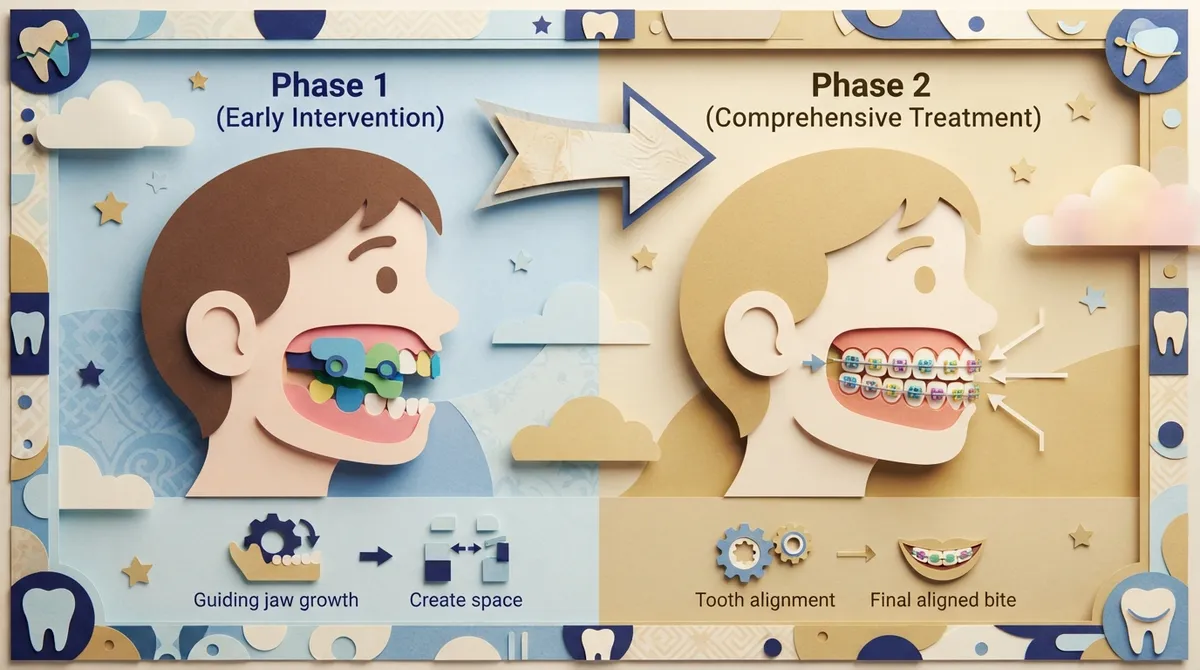
Two-phase treatment splits care into two parts with a rest period in between. Phase 1 happens while your child has a mix of baby teeth and permanent teeth. Phase 2 happens after most or all permanent teeth have come in.
Phase 1 has a narrow job. It might guide jaw growth, fix a significant bite mismatch, or make room for teeth that are trying to erupt. Phase 2 is the more familiar stage, when braces or clear aligners move the permanent teeth into their final spots.
Here is the part many parents miss: Phase 2 is not automatic. Some children finish Phase 1 and need only a retainer and monitoring. Others need full treatment later. Your orthodontist plans it based on how your child develops. For a deeper side-by-side look, see our phase one vs phase two orthodontics facts.
How the Two Phases Compare
| Feature | Phase 1 (Early) | Phase 2 (Comprehensive) |
|---|---|---|
| Typical timing | Mixed baby and permanent teeth | After most permanent teeth erupt |
| Main goal | Fix one specific developing problem | Align teeth and refine the bite |
| Common tools | Expanders, partial braces, other appliances | Braces or clear aligners |
| Required for every child? | No, only when a clear reason exists | No, depends on results of Phase 1 |
Why Some Children Need Two Phases of Treatment: 3 Key Reasons
There are many details in a child’s mouth, but most two-phase plans come down to three main situations. Each one is about timing, because some problems are easier to address while a child is still growing.
1. A Jaw or Bite Problem That Growth Can Help Guide
Some bite problems come from the way the upper and lower jaws line up. A child may have a pronounced underbite, a crossbite, or upper front teeth that stick out far past the lower teeth. While a child is growing, an orthodontist may be able to use that growth to help guide the jaws.
A common example is a narrow upper jaw. A palatal expander gently widens the upper arch so the teeth have room and the bite fits together better. You can read more in our palatal expander guide. Crossbites are another good example, and our article on crossbite treatment explains when early care makes sense.
Here is an honest note about prominent upper front teeth, often called a Class II bite. A large Cochrane review (updated January 2025) looked at 27 trials with 1,251 participants. It found that early two-phase treatment did not produce a meaningfully better final bite than one round of treatment started in the teen years. Final overjet differed by only 0.21 mm on average, and the jaw measurement (ANB) differed by just 0.02 degrees. So early treatment is not a magic upgrade for everyone.
2. Protecting Front Teeth From Injury
This is where the research does show a clear benefit. When upper front teeth stick out a lot, they are more likely to get chipped or knocked during play, sports, and everyday bumps.
The same Cochrane review found that new front-tooth injuries were less common in children who started early. In the functional-appliance trials, about 19% of the early group (31 of 161) had a new injury, compared with about 30% of the later group (51 of 171). In the headgear trials, 24 of 117 early-treatment children had new injuries, versus 44 of 120 in the later group. The certainty of that evidence ranged from moderate to low, so it is a helpful signal rather than a guarantee.
For an active child who plays sports or loves climbing, that protection can matter. It is a real, specific reason for Phase 1, and one worth talking about with your orthodontist.
3. Crowding or Eruption Problems That Need Room Now
Sometimes the issue is space. Severe crowding, teeth coming in the wrong spot, or a permanent tooth stuck behind a baby tooth can cause trouble if left alone. Early care can make room so permanent teeth come in more smoothly.
If you want to understand the root of the problem, read about what causes crowding in children’s developing teeth and our parent-friendly guide to retained baby teeth. Some children also have habits such as thumb sucking that affect how teeth and jaws develop, and an early plan can address both the habit and its effects.
Not every crowded smile needs two phases, though. Many children with mild crowding do just fine with a single round of treatment later. The key word is significant. Early care makes sense when waiting could make the problem harder to fix.
What Happens in Phase 1, the Rest Period, and Phase 2?
Knowing the flow of treatment takes away a lot of worry. Here is a simple look at how two-phase care usually unfolds.
- The evaluation. Your orthodontist reviews your child’s teeth, jaws, and growth, often with photos, scans, and X-rays. Learn more about what orthodontic X-rays can help evaluate.
- Phase 1 treatment. A targeted appliance or partial braces address the specific problem. It usually lasts a limited time rather than years.
- The resting and monitoring period. The appliances come off, and your child’s remaining permanent teeth erupt on their own. Regular checkups keep an eye on progress.
- The Phase 2 decision. Once most permanent teeth are in, your orthodontist decides whether full braces or aligners are needed.
- Phase 2 treatment and retention. Teeth are aligned, the bite is refined, and retainers help keep the results in place.
The rest period surprises many parents. It is not a sign that something went wrong. It is simply the pause that lets nature do its work. Regular visits during this time matter, and our post on why orthodontic checkups matter so much explains why.
Does an Early Check-Up Mean Braces Right Away?
No, and this is one of the biggest myths out there. The American Association of Orthodontists recommends an initial check-up by age 7. That is because enough permanent teeth have often come in by then for an orthodontist to spot developing bite or jaw concerns.
But a check-up is an evaluation, not a treatment plan. Many children are simply watched as they grow. Others need only one phase later. A smaller group benefits from an early start. We cover this idea in detail in how to understand why early evaluation isn’t treatment, and our guide on age 7 vs. waiting can help you decide on timing.
Think of it like a well-child visit. The goal is to catch anything important while there is time to act, and to give you peace of mind when nothing needs to be done.
The Trade-Offs of Two Phases: What Parents Should Weigh
Two-phase treatment can be a smart choice, but it comes with real trade-offs. Being honest about them helps you decide with confidence.
- More total time in treatment. Two phases with a rest period can add up to more months or years under orthodontic care.
- More appointments. Extra visits mean more school pickups and schedule juggling.
- More appliance wear. Some kids tire of expanders, headgear, or braces, especially if they wear them in two separate stretches.
- Possibly higher total cost. Two phases can cost more than one. Our article on how treatment length affects orthodontic costs in 2026 breaks down why.
On the other side, the benefits can be meaningful when there is a clear reason, such as protecting prominent front teeth or correcting a crossbite while the jaw is still growing. The goal is to match the plan to the child, not to follow a one-size-fits-all rule.
When Waiting Is a Perfectly Good Plan
For many children, the best plan is patience. If there is no urgent problem, your orthodontist may suggest watching as permanent teeth erupt and then treating in one phase during the early teen years. For Class II bites in particular, the research does not show that starting early gives a better final result than waiting for adolescence.
Waiting does not mean ignoring. It means regular monitoring so that if something changes, you can act at the right moment. If you are curious about the teen years, our guide on how growth affects a teenager’s orthodontic plan is a helpful read.
Smart Questions to Ask Before Starting Phase 1
You are your child’s best advocate, and good orthodontists welcome questions. Bring this list to your visit. Our post on how to ask the right questions about early treatment goes even deeper.
- What specific problem will Phase 1 fix, and what happens if we wait?
- What outcome should we expect, and how will we measure success?
- Is observation or a single later phase a reasonable alternative?
- How long will Phase 1 last, and what is the likely gap before Phase 2?
- Will my child definitely need Phase 2, or is it possible they won’t?
- What is the total expected cost and time for both phases combined?
If an answer feels vague, ask for it in plain words. A good plan should make sense to you and to your child.
Helping Your Child Succeed During Early Treatment
Kids do best when they feel included. Explain what the appliance does in simple terms. Celebrate small wins, like a good brushing week. Make cleaning a team effort, because appliances can trap food.
Habits matter more than anything. Our guide on how parents can help kids build appliance care habits offers friendly, practical tips. Keep a few soft, braces-friendly snacks on hand too, especially in the first week when teeth feel tender.
How Brockway Orthodontics Approaches Early Care in Clearwater
At Brockway Orthodontics, we treat early care as a thoughtful decision, not a sales pitch. Dr. Brockway takes time to listen to your concerns, explains what she sees in your child’s growth, and lays out every option in easy language. Sometimes that means starting Phase 1. Sometimes it means a simple “let’s watch and check back.”
Our office uses modern tools, including digital impressions in place of messy molds and 3D imaging to plan treatment precisely. That makes visits more comfortable for kids and gives us a clearer picture of your child’s development. When your child is ready for Phase 2, we offer metal braces, ceramic (clear) braces, and Spark™ Clear Aligners, a more affordable alternative to other clear aligner brands.
We also know families are busy. In certain cases, same-day treatment can help you start without juggling multiple visits. Want to see what other local families think? Read what our neighbors say when you visit us on Google — Brockway Orthodontics. You can also learn what a first appointment looks like in our guide to when your child should see an orthodontist. For general oral health guidance, the American Dental Association is a trusted resource, and you can find professional standards and directories through the Florida Association of Orthodontists.
Putting It All Together
So, why do some children need two phases of treatment? In short, it comes down to timing and purpose. Phase 1 makes sense when a growing child has a specific issue, such as a jaw mismatch, prominent front teeth at risk of injury, or crowding and eruption problems that need attention now. Phase 2 then finishes the job once the permanent teeth are in.
It is just as important to remember what two-phase care is not. It is not required for every child, it is not guaranteed to give a better final result than one later phase, and it can mean more time and cost. The best plan is the one built around your child’s actual needs.
If you are in the Clearwater area and wondering where your child fits, we would love to help you sort it out. Book a free consultation online and let Dr. Brockway take a look. You can also contact us with any questions first. No pressure, just friendly answers and a clear path forward for your child’s smile.
FAQs
Q: Why would a child need two phases of orthodontic treatment?
A: Two phases make sense when a growing child has a specific problem that is easier to address early, like a crossbite, a jaw mismatch, prominent front teeth, or crowding that blocks erupting teeth. Phase 1 handles that one issue, and Phase 2 later aligns the permanent teeth and refines the bite. Not every child needs both, and your orthodontist will tell you if yours does.
Q: Does every child who has Phase 1 need braces again later?
A: Not always! Some children finish Phase 1 and need only monitoring and a retainer, while others go on to braces or clear aligners once their permanent teeth come in. Phase 2 is planned based on how your child develops, so it is never automatic.
Q: At what age should a child have an orthodontic evaluation?
A: The American Association of Orthodontists recommends a first check-up by age 7, when enough permanent teeth have usually come in to spot bite and jaw concerns. This visit is just an evaluation. It does not mean your child has to start braces right away.
Q: Is two-phase treatment better than waiting until the teenage years?
A: For prominent upper front teeth, research does not show that early two-phase treatment gives a better final bite than one round of treatment in the teen years. The clearest proven benefit is a lower risk of front-tooth injury. Other bite problems may be different, so a personal exam is the best way to know.
Q: What are the downsides of two-phase orthodontic treatment?
A: Two phases can mean more total time in treatment, more appointments, more appliance wear, and often a higher overall cost than one phase. That is why it helps to ask what specific problem Phase 1 solves and whether waiting is a reasonable option.
Our Service Area