Key Takeaways
-
An early orthodontic evaluation is a check-up to look at growth, while early treatment is an active plan to fix a specific problem; one does not automatically lead to the other.
-
The American Association of Orthodontists recommends a first check-up by age 7, or sooner if you notice a concern, when a mix of baby and permanent teeth gives a useful view.
-
Many children leave their first evaluation needing no treatment, or simply being monitored with periodic check-ups as their teeth and jaws grow.
-
Early treatment is typically reserved for issues like certain crossbites, harmful habits such as long-term thumb sucking, impacted teeth, severe crowding, or unfavorable jaw growth.
-
A Cochrane review found two-phase early treatment reduced front tooth injuries in children with prominent upper front teeth, but showed no other clear advantages, with low-to-moderate evidence quality.
-
Early treatment does not always eliminate the need for later braces or aligners, so ask your orthodontist about total treatment time and cost before committing to a two-phase plan.
If your child’s seventh birthday is coming up, you may have heard someone say, “Time for the orthodontist!” That can sound a little scary. Does it mean braces on a second grader? Take a deep breath, because the answer is almost always no.
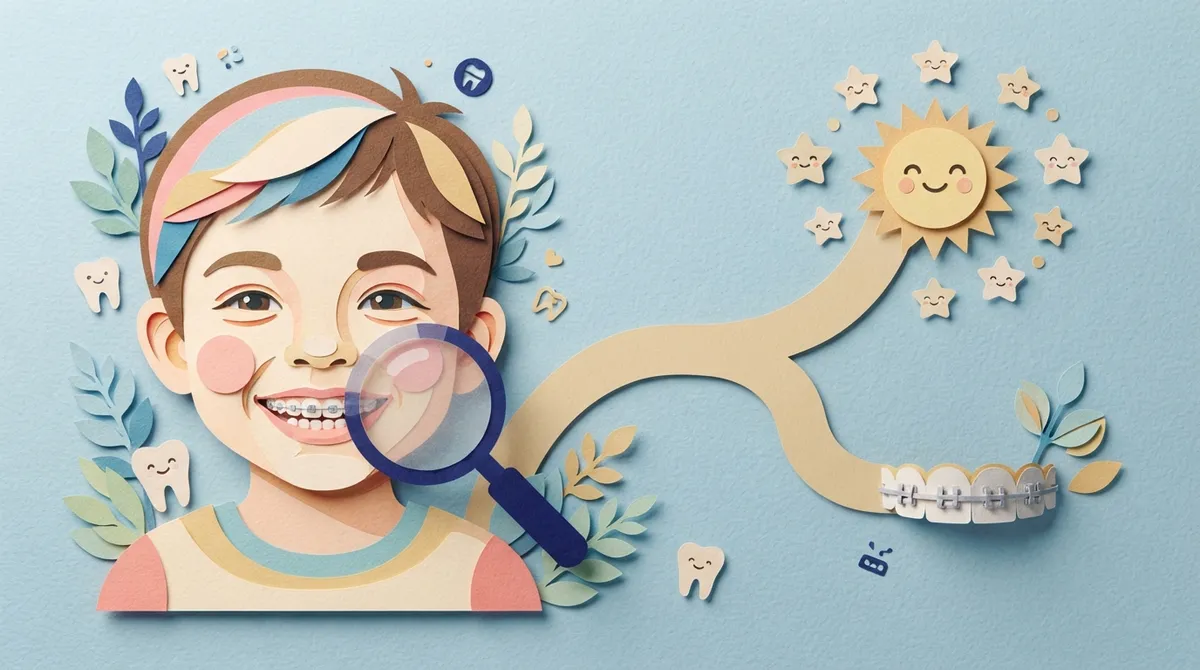
Here’s the good news. An early orthodontic evaluation and early treatment are two very different things. One is a friendly look at how your child’s smile is growing. The other is a plan to fix a specific problem while your child is still growing. Many kids get the first one and never need the second right away.
In this guide, we’ll break down the early orthodontic evaluation versus early treatment question in plain, simple terms. You’ll learn what each one means, what happens at a first visit, and which problems may call for action sooner rather than later. We’ll also look at what the research says, so you can feel calm and confident about your next step. At Brockway Orthodontics, we love helping Clearwater families sort this out, one smile at a time.
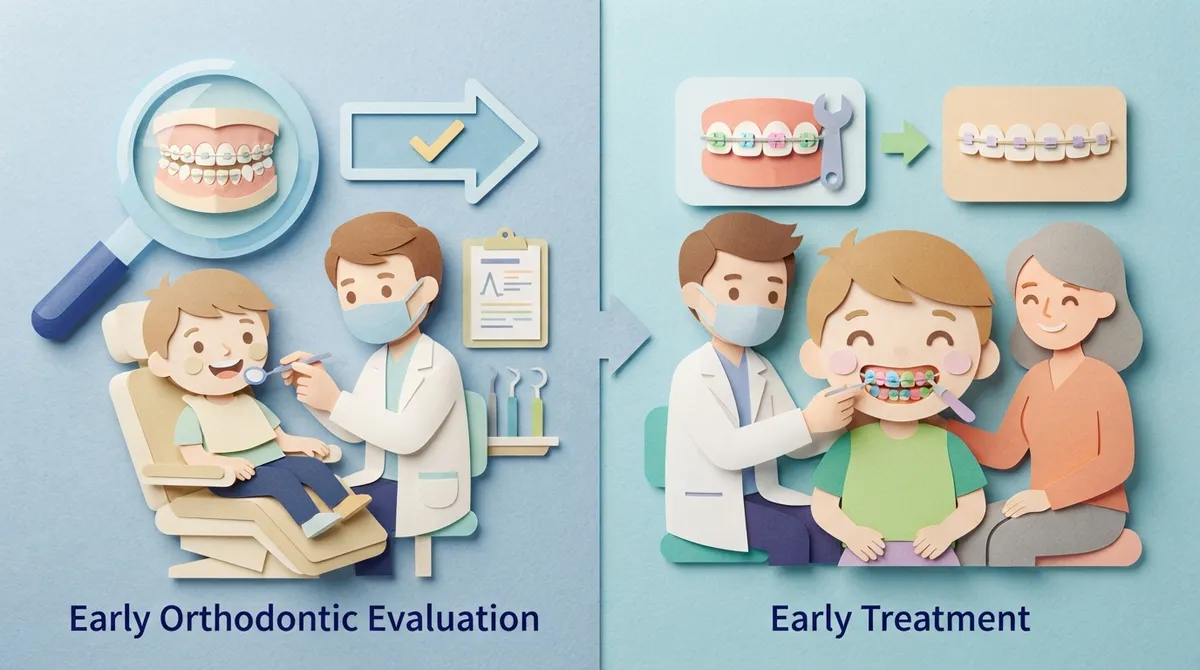
Early Orthodontic Evaluation vs. Early Treatment: The Quick Answer
Let’s start with the simplest version. An early evaluation is a check-up. Early treatment is a plan to correct something. They are not the same, and one does not automatically lead to the other.
An evaluation is a chance for an orthodontist to look at your child’s teeth, bite, and jaws while they are still developing. It does not mean treatment must begin. In fact, many children are simply watched over time and start treatment later, if they need it at all.
Early treatment, often called Phase 1 or interceptive treatment, starts while some baby teeth are still in the mouth. It is saved for certain problems where acting during growth may help.
| Feature | Early Evaluation | Early Treatment |
|---|---|---|
| What it is | A check-up and assessment | Active care to correct a problem |
| Typical timing | By age 7, or sooner if there’s a concern | Depends on the problem and your child’s growth |
| Commitment | None. It’s a look, not a plan to start braces | A planned course of care |
| Tools used | Exam, photos, sometimes X-rays | Expanders, partial braces, or other appliances |
| Who needs it | Nearly every child can benefit | Only children with certain issues |
| Possible outcomes | No treatment, monitoring, or treatment | May still need later braces or aligners |
Why Age 7 Is the Magic Number for a Check-Up
The American Association of Orthodontists recommends a first orthodontic check-up by age 7, or sooner if you notice a concern. That number is not random. It is a milestone for looking, not a starting line for braces.
At about age 7, many kids have a mix of baby teeth and permanent teeth. That mix gives an orthodontist a helpful window. They can see how teeth are coming in, how the upper and lower jaws line up, and whether crowding is starting to show. All of this happens while growth is still going on.
If you want to dig deeper into timing, our guide on age 7 versus waiting for a first orthodontic visit walks through the pros and cons in a friendly way. You may also like our piece on when your child should see an orthodontist.
What Happens at an Early Orthodontic Evaluation?
Many parents worry the first visit will be long or stressful. It’s usually the opposite. Think of it as a gentle “get to know you” appointment for your child’s smile.
Here is what a typical evaluation may look like:
- A warm welcome. We chat with you and your child about any concerns, habits, or family history.
- A look at the teeth and bite. We check which teeth have come in, how they meet, and whether anything looks out of place.
- A check of jaw growth. We look at how the upper and lower jaws relate to each other.
- Records, if needed. This may include photos, digital scans, or X-rays. Modern tools like intraoral scanning make this easy and comfortable, with no messy molds.
- A clear talk afterward. We explain what we see in simple words and answer your questions.
Not sure what to ask? Our post on why early evaluation isn’t treatment can help you feel ready.
The Three Common Results After an Evaluation
After the exam, most families land in one of three groups. Knowing these ahead of time can take a lot of the worry out of the visit.
- No treatment needed. Your child’s teeth and bite look healthy for their age. You go home with peace of mind.
- Watch and wait. Something may need attention later, but not yet. We schedule periodic check-ups to follow growth and tooth eruption.
- Early treatment recommended. A specific problem may benefit from care during growth, so we talk through the options.
Many children do not need treatment at the first visit. That’s a good thing! Regular monitoring lets us catch changes at the right moment without rushing into anything. You can learn why this matters in our article on why orthodontic checkups matter so much.
What Is Early Orthodontic Treatment, Exactly?
Early treatment, also called Phase 1 or interceptive treatment, begins while some baby teeth remain. Depending on the diagnosis, it may use tools such as palatal expanders or partial braces to address a problem while the jaws are still growing.
It’s important to know that early treatment does not always remove the need for later braces or aligners. Sometimes a child has a short first phase, a resting period while the rest of the permanent teeth come in, and then a second phase if needed. To understand how the two stages differ, check out these phase one versus phase two orthodontics facts.
If your child’s orthodontist suggests an expander, our palatal expander guide explains what to expect in a friendly, step-by-step way.
Problems That May Benefit From Early Intervention
So when does it make sense to act sooner? Orthodontic guidelines point to a handful of situations where early care may help. The right timing depends on the condition, your child’s dental development and growth, the risks and benefits, and your family’s circumstances.
Here are some common reasons an orthodontist may recommend starting early:
- Certain crossbites. When upper teeth bite inside the lower teeth, it can affect jaw growth. Learn more in what crossbite treatment is and whether you need it.
- Harmful oral habits. Long-term thumb sucking, for example, can influence how teeth and jaws develop.
- Ectopic or impacted teeth. Teeth that are coming in off course or getting stuck may need guidance.
- Severe crowding or space problems. Some cases benefit from making room early. See what causes crowding in children’s developing teeth.
- Unfavorable jaw growth. When the jaws are growing out of balance, guiding growth early can sometimes help.
If you spot something like prominent front teeth, our article on protruding front teeth and what an evaluation shows is a helpful read.
Is Early Treatment Always Better? What the Research Says
Here’s a point that surprises many parents. Early treatment is not automatically better, and it is not necessary for every child. For many alignment problems, treatment can wait until more permanent teeth have come in. The right start time is personal to each child, not decided by age alone.
Research backs this up. A Cochrane review looked at 27 studies with 1,251 participants, focused on children with prominent upper front teeth (often called Class II Division 1). Here is what it found:
- Two-phase early treatment reduced the chance of injury to the front teeth, compared with one-phase treatment in the teen years.
- In the headgear comparison, front tooth injury happened in 24 of 117 children treated early, versus 44 of 120 treated later (odds ratio 0.45).
- Beyond that, the review found no other clear advantages of early treatment.
- The evidence was rated low to moderate in quality.
In plain words, early treatment can protect front teeth from bumps and breaks in some children. But it does not seem to give a big edge in other ways for that specific problem. That’s why a careful, one-on-one evaluation matters so much.
Early Evaluation vs. Waiting: Which Is Wiser?
You might wonder, “Why not just wait until all the adult teeth are in?” It’s a fair question. Waiting is often fine. But skipping the early look means you might miss a problem that is easiest to handle while your child is growing.
An evaluation gives you information without pressure. If everything looks good, you can relax. If something needs watching, you have a plan. And if early care would help, you find out at the right time. Skipping that first look can mean surprises later, which is why we wrote about mistakes parents make skipping early orthodontic treatment. You can also read waiting versus early check-ups and how permanent teeth erupt for more on timing.
| Approach | Possible Upside | Possible Downside |
|---|---|---|
| Early evaluation by age 7 | Catches issues early; gives peace of mind; builds a plan | Often leads to “just watching,” which can feel like a wasted visit to some |
| Early treatment when needed | May guide growth or protect teeth | May not replace later braces; adds a phase |
| Waiting with no check-up | No early appointment needed | A growth-sensitive problem might go unnoticed |
What Early Treatment Can and Can’t Do
It helps to keep expectations real. Early treatment is a tool for specific jobs. It is not a magic shortcut that guarantees a one-and-done smile.
It can help guide jaw growth, make space for teeth, correct certain bite problems, and reduce risk to protruding front teeth. It may not prevent the need for braces or aligners later, and it won’t necessarily shorten your teen’s total time in treatment.
Costs and time matter too. A two-phase plan can affect your budget and schedule, so ask about it up front. Our guides on how treatment length affects orthodontic costs and free versus paid braces consultations can help you plan.
Tips for Parents: How to Make the Most of the First Visit
A little prep goes a long way. Here are some easy ways to get ready:
- Write down your questions. Jot them in your phone so you don’t forget in the moment.
- Note any habits. Thumb sucking, pacifier use, mouth breathing, or teeth grinding are all worth mentioning.
- Share your family history. If crowded teeth or jaw issues run in the family, tell us.
- Bring your dental info. Let us know about any past injuries or dental work.
- Keep it positive. Tell your child it’s just a friendly visit to look at their smile.
You can also read how to prepare for your orthodontist consultation for a handy checklist.
Who Else Should Care About Early Evaluation?
While this topic is mostly about kids, the same thinking applies across ages. Teens may be at a perfect point for braces or aligners, and adults can benefit from a check-up too. If your older child is heading into the teen years, our post on when your child should get braces is a great next read. And for teens weighing options, 12 questions teens should ask their orthodontist is a fun place to start.
Why Clearwater Families Trust Brockway Orthodontics
At Brockway Orthodontics, we believe every family deserves clear, honest guidance. Dr. Brockway takes the time to listen, explain what she sees, and walk you through your choices without pressure. We use modern tools like digital scans and 3D imaging, so visits are comfortable and precise. If you’re ready to meet the team, you can read more about Dr. Brockway and see what neighbors say when you visit us on Google — Brockway Orthodontics. For general dental health guidance, the American Dental Association is a trusted resource too.
The Bottom Line
Let’s wrap it up with the simplest takeaway. An early orthodontic evaluation is a look. Early treatment is a plan. You can have the first without ever needing the second.
For most kids, a check-up by age 7 is a smart, low-pressure move. It gives you facts, not pressure. If your child needs early care, you’ll know the best time to start. If not, you’ll have peace of mind and a plan to keep watching.
Ready to take the first step? Book your child’s appointment online and let’s take a friendly look at that growing smile together. Have questions first? Just contact us. We can’t wait to meet you!
FAQs
Q: What is the difference between an early orthodontic evaluation and early treatment?
A: An early evaluation is a friendly check-up where we look at your child’s teeth, bite, and jaws. It does not mean treatment has to start. Early treatment is active care, like an expander or partial braces, used only when a specific problem may benefit from help during growth.
Q: At what age should my child have their first orthodontic evaluation?
A: The American Association of Orthodontists recommends a first check-up by age 7, or sooner if you notice a concern. At that age, kids usually have a mix of baby and permanent teeth, which gives us a great window to see how things are growing.
Q: Does an evaluation at age 7 mean my child needs braces?
A: Not at all! Many children leave the first visit with no treatment needed, or with a simple plan to watch and check back later. The visit is about gathering information, not signing up for braces.
Q: Can early treatment prevent braces later?
A: Sometimes early treatment makes later care simpler, but it does not always remove the need for braces or aligners. Research on prominent upper front teeth found that early two-phase treatment lowered the chance of front tooth injury, but showed no other clear advantages.
Q: What problems may benefit from early orthodontic treatment?
A: Some examples include certain crossbites, harmful oral habits, ectopic or impacted teeth, severe crowding or space problems, and unfavorable jaw growth. The best timing depends on your child’s growth, the condition, and your family’s needs, so a one-on-one exam is the best way to know.
Our Service Area