Key Takeaways
-
Dental crowding means there isn't enough room in the jaw for teeth to line up, causing overlapping, twisting, or out-of-position teeth; it is common and usually very treatable.
-
Crowding is usually caused by a mismatch between tooth size and jaw size, often inherited, and can also result from early or late loss of baby teeth, extra teeth, or teeth erupting at odd angles.
-
Crowded teeth are not a dental emergency, but overlapping teeth create hard-to-reach spots, so extra care with brushing, floss threaders, interdental brushes, or a water flosser helps protect oral health.
-
Treatment depends on the individual: options include braces, clear aligners, arch expansion, interproximal reduction, or extraction, and extractions are only used when other methods cannot create enough room.
-
Clear aligners can often treat mild to moderate crowding, but an orthodontist must first check your bite and teeth to determine whether aligners or braces are the better fit.
-
Many orthodontists suggest a first check around age 7, when adult teeth begin to appear, so growth can be monitored and treatment timing chosen, even if no immediate treatment is needed.
Have you ever looked in the mirror and noticed that your front teeth seem to be squeezing past each other, like people trying to fit onto one small bench? If so, you may be wondering what is dental crowding, and whether it is something to worry about. The short answer: it is a very common bite and alignment concern, and it is usually very treatable.
Dental crowding happens when your teeth do not have enough room to line up neatly in your jaw. Teeth may overlap, twist, or tuck in front of or behind their neighbors. It can show up in kids, teens, and adults alike. Maybe you spot it when your child’s permanent teeth start to come in. Maybe you notice your lower front teeth getting more crooked over time.
In this friendly guide, we will walk through what dental crowding means, what causes it, how an orthodontist checks it, and which treatments can help. We will keep things simple and jargon-free, so you can feel confident about your next step.
What Is Dental Crowding?
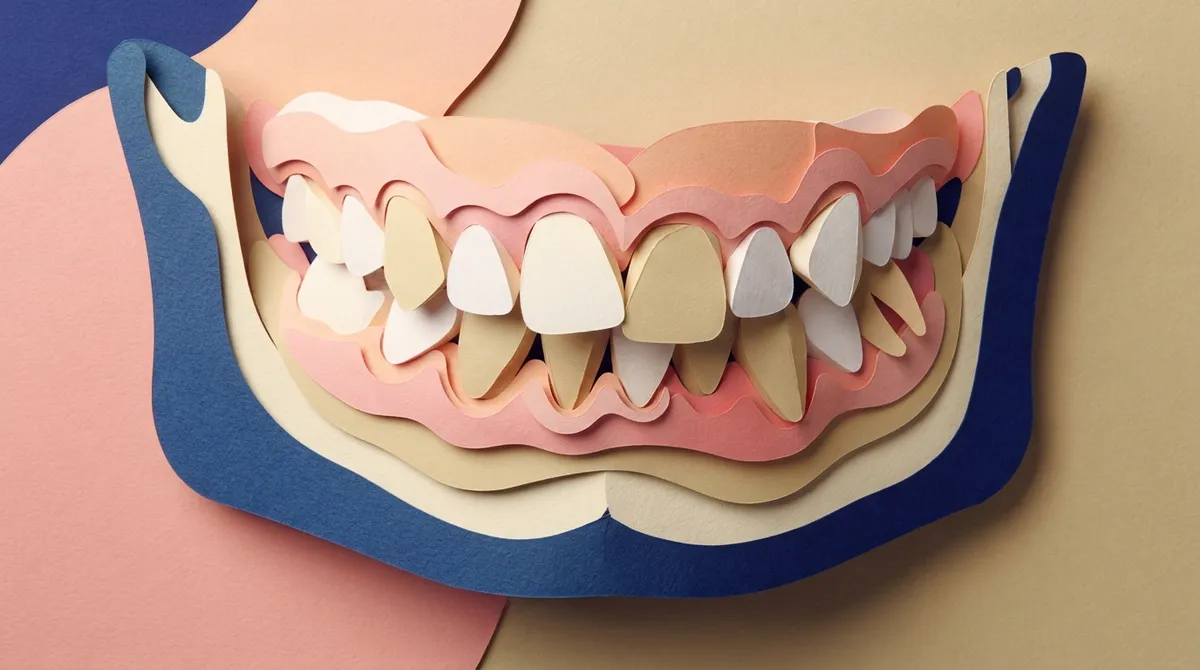
Dental crowding is a type of malocclusion, which is just the orthodontic word for teeth that do not fit together or line up the way they should. With dental crowding, there is not enough space in the dental arch (the curved row of teeth in your upper or lower jaw) for every tooth to sit in its proper spot. As a result, teeth may overlap, rotate, or erupt out of position.
Think of it like parking cars. If the parking lot is too small for the number of cars, some will end up parked at odd angles or squeezed in sideways. Your teeth work the same way. When the “lot” is too small or the “cars” are too big, something has to give.
Mild, Moderate, and Severe Crowding
Not all crowding looks the same. An orthodontist usually describes it by how much space is missing. The table below gives a simple overview.
| Level | What It Often Looks Like | Common Concerns |
|---|---|---|
| Mild | One or two teeth slightly twisted or overlapping, often on the lower front teeth | Appearance, slightly harder to floss |
| Moderate | Several teeth overlapping or rotated across the upper or lower arch | Cleaning difficulty, uneven bite contacts |
| Severe | Teeth pushed far out of line, or some teeth blocked from coming in properly | Trouble cleaning, bite changes, and impacted or unerupted teeth |
Keep in mind that only an orthodontist can tell you where your smile falls on this scale. A quick exam gives you real answers, not guesses.
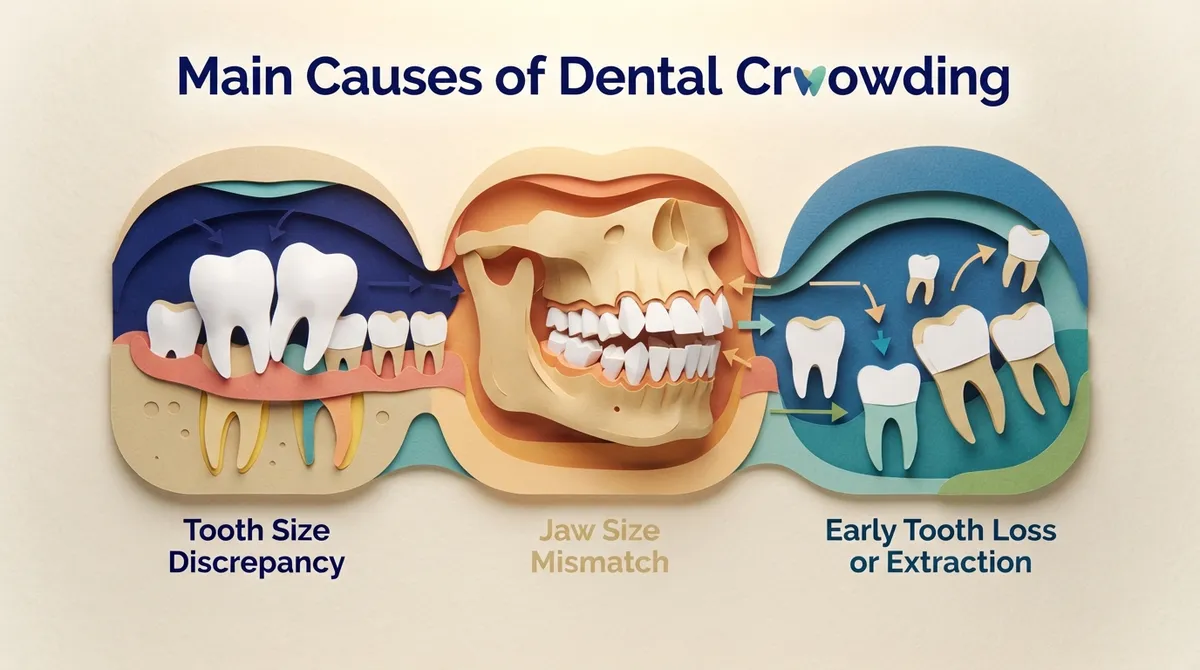
Why Does Crowding Happen? The Main Causes
Crowding is not caused by one single thing. Most of the time, it comes from a mix of factors. The most common root issue is a mismatch between tooth size and arch space. In other words, your teeth may be relatively large, your jaw may be relatively small, or both.
Here are the common contributors:
- Inherited traits: Tooth size and jaw size often run in families. If a parent had crowded teeth, a child may too.
- Early loss of baby teeth: Baby teeth hold space for the adult teeth coming in behind them. When one is lost too early, nearby teeth can drift into the gap.
- Baby teeth that stay too long: A retained baby tooth can block an adult tooth, pushing it out of line.
- Extra teeth: Sometimes a person has an extra tooth that takes up valuable space.
- Blocked or altered eruption: Teeth that come in at the wrong angle or in the wrong order can lead to crowding.
- Changes with age: Arch length can shrink a little over the years, which is why lower front teeth sometimes get more crowded later in life.
If you are curious about the childhood side of this, our article on what causes crowding in children’s developing teeth goes deeper. For a close look at the lower front teeth specifically, see why lower front teeth can become crowded.
Signs You May Have Crowded Teeth
Crowding is often easy to spot, but some signs are subtle. Here are things people commonly notice:
- Teeth that overlap each other when you smile.
- Teeth that look twisted or turned sideways.
- A tooth that sits in front of or behind the rest of the row.
- Floss that shreds, catches, or is hard to slide between teeth.
- Adult teeth coming in behind baby teeth in a child.
- Teeth that seem to be shifting or getting more crooked over time.
If any of these sound familiar, you are not alone. We cover more about this topic in our guide to 5 signs you need an orthodontist for crowded teeth.
Is Dental Crowding Common?
Crowding is considered one of the most frequent alignment concerns orthodontists see. But here is an honest note: there is no single, universal number for how many people have it. Prevalence changes a lot depending on the population studied, the age group, the stage of tooth development, and how “crowding” is defined and measured.
For example, a 2026 systematic review that looked at 14 studies found that larger tooth size combined with smaller arch dimensions is linked to crowding. One study in that review, done in Tabasco, Mexico, reported a high rate of late lower-arch crowding. That result applies to that specific group of people, so it should not be treated as a rate for everyone. The same review also noted that studies do not show a consistent difference in crowding between males and females.
The takeaway? Crowding is common, it has many causes, and your own situation is best judged by a professional rather than by a statistic.
Does Crowding Affect Oral Health?
Crowded teeth are not a dental emergency. Still, they can make daily care a bit trickier. The American Association of Orthodontists notes that crowded teeth can make cleaning more difficult and may be linked to oral-health concerns when plaque builds up in hard-to-reach spots.
It is important to be clear here: crowding alone does not mean you have tooth decay or gum disease. Plenty of people with crowded teeth keep their mouths healthy with good brushing, flossing, and regular checkups. But overlapping teeth do create tight corners where a toothbrush may not reach easily, so extra care helps.
Crowding can also affect how your teeth meet when you bite. If you are curious about that connection, take a look at our piece on why your bite needs an orthodontist’s attention.
How Orthodontists Diagnose and Measure Crowding
When you visit an orthodontist, the goal is to understand not just how your teeth look, but why they are crowded. That helps shape a plan that fits you personally. An assessment usually looks at:
- Where the crowding is and how severe it is
- How your upper and lower teeth and jaws relate to each other
- Which teeth have come in and which are still on the way
- Your facial profile
- Your age and how much growth is still ahead
- The health and long-term outlook of your teeth and gums
To measure crowding, orthodontists often use models of your teeth or digital scans. X-rays may be taken when they are needed to see teeth under the gums or check the roots and jaw. Today, many practices use quick digital scanning instead of goopy molds. You can read more about that in 10 facts about Medit intraoral scanning for ortho.
At Brockway Orthodontics in Clearwater, Florida, Dr. Brockway takes time to listen to your goals and concerns first. Then she explains what she sees in plain, friendly language, so you know exactly what to expect.
Treatment Options for Crowded Teeth
The big idea behind treating crowding is simple: create enough room so the teeth can line up. How that space is made depends on the person. Here are the main approaches.
| Option | How It Helps | Often Considered When |
|---|---|---|
| Braces | Brackets and wires gently move teeth into better positions | Moderate to severe crowding, or complex tooth movement |
| Clear aligners | A series of clear, removable trays shift teeth step by step | Mild to moderate crowding in suitable patients |
| Expansion | An appliance widens the arch to create more room | Growing patients with a narrow arch |
| Interproximal reduction | A tiny amount of enamel is polished between selected teeth | Mild crowding where small space is needed |
| Extraction | One or more teeth are removed to create space | Significant crowding where other methods will not make enough room |
Here is something that surprises many people: crowded teeth do not always need extractions, and they do not always need braces. Treatment is truly individualized. Your orthodontist weighs your age, your bite, your goals, and your teeth before recommending a path.
Braces for Crowding
Braces remain a trusted, effective choice, especially when crowding is more complex. They give your orthodontist a lot of control over each tooth. Brockway Orthodontics offers both traditional metal braces and ceramic (clear) braces, so you can pick what fits your style. Not sure which is right? Our guide on metal vs. ceramic braces can help.
Clear Aligners for Crowding
Yes, clear aligners can often treat dental crowding, particularly mild to moderate cases. They are discreet, removable, and popular with teens and busy adults. Brockway Orthodontics offers Spark™ Clear Aligners, an affordable option for people who want a nearly invisible way to straighten their teeth. To learn how aligners shift teeth, read how removable aligners straighten teeth. You can also compare choices in braces vs. clear aligners for crowded teeth.
Crowding in Kids, Teens, and Adults
Parents of Children
If you are a parent, you may spot crowding as your child’s adult teeth start arriving. Seeing teeth stack up or come in behind baby teeth can feel worrying, but it does not always mean treatment is needed right away. An early check lets an orthodontist watch growth and decide the best timing. Learn more in age 7 vs. waiting: when should a child see an orthodontist.
Teens and Young Adults
Teens often want a straighter smile before big life moments like graduation or prom. The good news is that today’s options, including clear aligners and ceramic braces, are far more discreet than in the past. Our 12 questions teens should ask their orthodontist is a handy starting point.
Adults and Relapse Patients
Adults can absolutely fix crowding too. Some had braces years ago and notice their teeth shifting back, especially the lower front teeth. That is called relapse, and it is common when retainers are not worn as directed. If this sounds like you, you may enjoy why bottom teeth shift most without a retainer. Busy professionals can also explore why invisible braces for adults are so popular in 2026.
Keeping Crowded Teeth Healthy While You Wait
Whether you are planning treatment or just thinking about it, a few small habits make a big difference:
- Brush twice a day and take extra time on overlapping spots.
- Use floss threaders, interdental brushes, or a water flosser for tight areas.
- Keep up with regular dental cleanings.
- Ask your orthodontist to show you the best technique for your teeth.
The American Dental Association offers helpful general guidance on daily oral care. And once treatment is done, wearing your retainer is the best way to protect your results.
How Brockway Orthodontics Can Help
If you are searching for a caring orthodontist in Clearwater, Florida, Brockway Orthodontics is here for you and your whole family. Dr. Brockway offers braces, ceramic braces, and Spark™ Clear Aligners, using modern tools like digital impressions and 3D imaging for comfortable, precise planning. In certain cases, same-day treatment may even be possible for busy families.
Want to hear from real patients? You can visit us on Google — Brockway Orthodontics to see what our Clearwater community says. For a sense of what to expect when you arrive, check out what to expect at the orthodontist: your first visit guide. To better understand credentials, the Florida Association of Orthodontists is a great resource for learning about orthodontic care in our state.
Ready to Find Out What Is Going On With Your Smile?
Now you know what dental crowding is, why it happens, and how it can be treated. The best next step is a personal exam, because every smile is different. There is no pressure and no judgment, just clear answers and a plan that fits your life.
Ready to take the first step? Book your appointment online or contact our friendly team with any questions. We would love to help you smile with confidence in 2026 and beyond.
FAQs
Q: What does dental crowding mean?
A: Dental crowding means your teeth do not have enough room to line up neatly in your jaw. Because of that, teeth may overlap, twist, or sit out of position. It is a common type of malocclusion, and an orthodontist can tell you how mild or serious it is.
Q: What causes crowded teeth?
A: Crowding usually comes from a mismatch between tooth size and jaw space, and genetics often play a big part. Losing baby teeth too early, keeping them too long, having extra teeth, or having teeth that come in at odd angles can all add to it. Some people also see lower front teeth get more crowded with age.
Q: Do crowded teeth always need braces or extractions?
A: Not at all! Treatment is tailored to each person, and options may include braces, clear aligners, expansion, or tiny reshaping between teeth. Extractions are only one possible tool and are used when other methods cannot make enough room.
Q: Can clear aligners treat dental crowding?
A: Often, yes, especially for mild to moderate crowding in the right patient. Your orthodontist will check your bite and teeth first to see if aligners are a good fit, or if braces would work better for you.
Q: When should a child be evaluated for crowded teeth?
A: Many orthodontists suggest a first check around age 7, when adult teeth begin to appear. An early look does not always mean early treatment. It simply lets your orthodontist watch growth and pick the best time to act, if action is needed.
Our Service Area